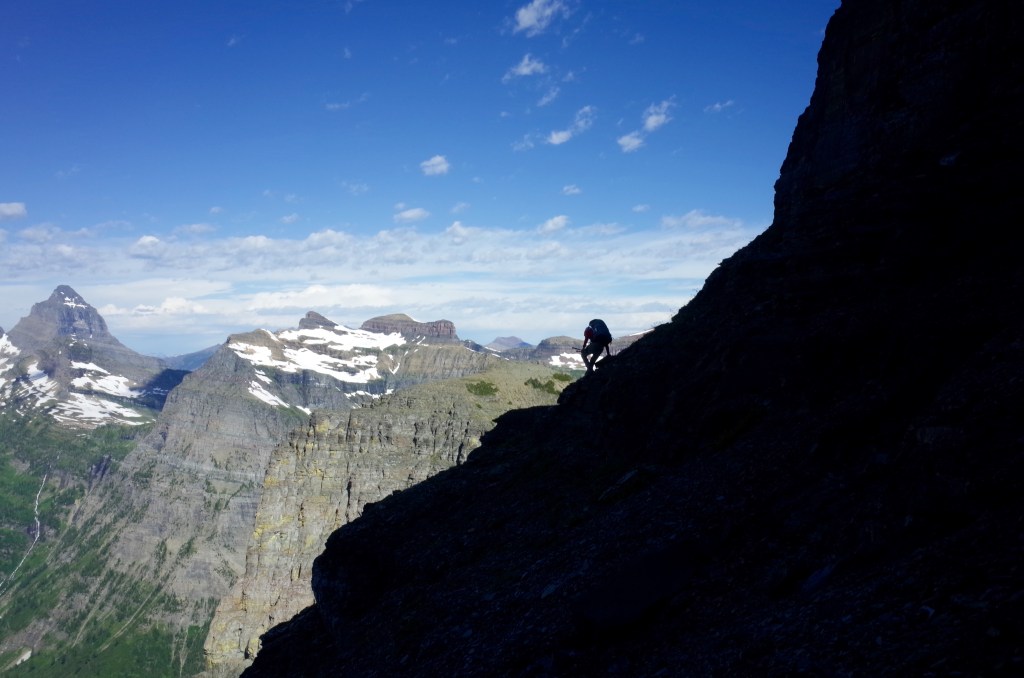
I dream of a hard and brutal mysticism in which the naked self merges with a non-human world and yet somehow survives still intact, individual, separate. Paradox and bedrock. -e.a.
Compiled by Dave Chenault; links to individual reports at the bottom.
The 2013 Bob Open ran from the Benchmark trailhead in the southeast Bob to the Bear Creek trailhead where Highway 2 meets the Middle Fork of the Flathead. 11 people, including the first woman in the events short history, took the start. Kind weather contributed to a 100% completion rate, with many excellent routes and stories generated. Significantly, all but two of last years seven starters were repeat offenders.
Saturday, May 25th dawned with cold weather and blue skies. First down the trail to the South Fork of the Sun were Dan Durston of Ontario, Greg Gedney of Colorado, and Greg Gressel of Pennsylvania. Durston and Gedney planned to take White River Pass over to packraft the South Fork of the Flathead, while Gressel planned to follow the CDT along the Chinese Wall before striking north over Spotted Bear and Pentagon Passes on a direct line to Schafer Meadows on the Middle Fork. Durston and Gedney found little more than a mile of snow at the pass and inflated boats at the White River at 1630, after 8.5 hours on the trail. They found the continuous small rapids of the White to be enjoyable, and the South Fork, which was running at 9000 cfs, to be very fast. They averaged 6-7 mph, and were approaching Meadow Creek gorge as the sun set. In one of the micro-gorges below Mid Creek Durston punched a big wave, hit a lateral, flipped, and swam. Gedney, whose last sight was Durston disappearing around the corner bow wildly elevated, eddied out river left, a task made more difficult by the 8 inches of water in his boat.
Meanwhile, Gressel was was putting his practiced thru-hiker legs to good use along the Chinese Wall. He hit continuous snow around 6ooo’, but found it mostly consolidated and thus good traveling. Despite getting off route near the notoriously confusing (in the snow) Larch Hill junction, Gressel rolled with the punch and dropped down into Juliet Creek before climbing back up to drop down Hoop Creek and meet back up with trail on the upper Spotted Bear. Darkness caught him at the ridge, and he camped in a tree well with a 30 mile day in the bag.
The rest of the participants took the route of least resistance down the S Fork of the Sun, before hiking up the N Fork Sun valley towards Sun River pass. I found the Sun to be excellent, if cold, packrafting, and arrived at Sun River Butte in little over two hours. I took the west side trail up through Gates Park, used the boat to cross the impressively big N Fork at Lick Creek, and camped near Monroe Creek, tired after a long day. Cyrus and Kate, from Minneapolis, also had rafts and took the same route. Andrew Farland, Chris Steutterman, and John St. Laurent teamed up and after hiking down the S Fork, crossed the pack bridge at the ranch and went up lower Arsenic Creek to follow the east side trail, camping near Headquarters Creek after an enjoyable 27 mile day.
Saturday night was clear and cold, with valley temperatures well below freezing. Everyone woke to frozen shoes and gear Sunday morning. Durston was especially motivated, with a goal of finishing that day reinforced by a small food bag. The night previous he had righted his raft, ran the next rapid with fogged glasses, made the takeout, wrung out his clothes, and hiked a half mile of trail to warm up before stopping at 2200 to make a fire, dry out, and sleep. Though Saturday had been a 50 mile day, Durston was on the trail at 0530 in good spirits, back on the river below Meadow Creek gorge, and taking out at Twin Creeks by 1000. Durston choose the trail up Upper Twin and North Creeks because it was more trafficked and didn’t gain and loose elevation, though the lower elevation snow punished this choice with miles of filled-in sidehilling. Durston persevered through snow and later deadfall in Long Creek, making the Middle Fork at 2000 and the parking lot by 2300, completing an impressive ~100 mile tour de force in 39 hours. More impressive, the next day Durston rallied, solo, for the 23 hour drive back home.
Gedney woke up above the aforementioned micro-gorge, having slept around a fire, and had a more leisurely morning. By the time he found Durston’s ok message (written in sticks on the trail) Gedney was 3 hours behind. He had an uneventful float down to Twin Creeks, and choose the lower Twin Creeks trail, which entailed a steep climb up snow to the divide but overall seemed a bit easier than Durston’s route. Dark caught Gedney at the ridge, and like Gressel before him he bivvied in a tree well.
Gressel himself got moving at 0600 and after negotiating the usual maze of deadfall and rotten snow in the lower elevations of Hoop Creek, found the trail again and beat tracks down and then up to Pentagon Pass and Dolly Varden Creek. The afternoon was bluebird and almost hot, and Gressel found himself at the Middle Fork at 1830, right as rain rolled in, preparing for the crux of his route: crossing the river without a boat. Though mentally and logistically prepped for a swim Gressel (and his long legs) choose a savvy spot which made for a surprisingly mild waist deep and upright crossing. Chilled from the wade and rain, Gressel hiked a few more miles before making camp at 2000 a little beyond Schafer.
I woke to sore feet and gorgeous weather, which continued as I dodged deadfall over Sun River pass. Reaching Strawberry Creek around 1030, I took a coffee break before inflating my boat and enjoying a superlative float down the Middle Fork. The impressive floods of a few weeks before had ripped some bank down, creating fresh log jams near Gooseberry, but overall the 11000 cfs (@ West Glacier) level proved ideal for packrafting. I made the 22 miles to below Schafer in a rather leisurely 5 hours. Strawberry had been surprisingly low, but I assumed Lodgepole Creek would be a different story. It was. At 1700 Sunday afternoon the normal ford on the Big River trail was running fast and waist deep at the far side. After securing my gear, and putting on my PFD under my pack, I made the crossing without incident. Rain caught me near Granite Creek, and soon thereafter sore feet and a pace slowed by deadfall stopped me for the evening around 2000 on the east side of 25 Mile Creek. I slept long, easily, and well.
Andrew, Chris and John enjoyed the excellent weather as well, with Andrew describing the upper reaches of the N Fork valley as the visual highlight on their journey. St. Laurent dropped off the pace before Sun River pass, bothered by swollen achilles tendons. Stuetterman and Farland crossed Strawberry at 1800, relieved that it was so mild, and hid from the rain on the porch of the Gooseberry patrol cabin. They celebrated Farland’s birthday, and what they erroneously thought was the crux of their route, with dehydrated cake and nutella before bedding down. St. Laurent reached Strawberry at dusk and camped on the south shore, enjoying his choice of a larger tarp than last year as the rain beat down.
Monday dawned cool and foggy in the Middle Fork drainage, with at least five Bob Open hikers camped along 35 miles of the river. 25 Mile creek, which had looked short but intimidatingly deep and fast the night before, seemed a bit more mild come morning with a belly of hot coffee. Once again I put on my PFD and crossed easily. The remaining miles went slowly, but I reached the parking lot shortly after 1200, was congratulated by Gedney’s wife Kate, and celebrated with some more coffee and a nap in the sun. Gedney was on the move at first light, crossed the Middle Fork around 0900, and made it to the parking lot around 1330. He and I toasted two excellent routes with beers, and headed back to Whitefish for pizza.
Gressel was also on the move early Monday, crossing Lodgepole at the lower and slightly steeper ford, getting caught by the current and face planting in the process, but with no harm done aside from a wet iPhone and clothes. Gressel made short work of the intimidating 25 Mile crossing, and generally continued to be the Open’s fastest walker, even in the face of heinous chaffing which had him walk most of the final 12 miles naked from the waist down. He finished at 1530, saying that the route exceeded his expectations. High praise from a well-traveled hiker.
Stuetterman and Farland were on the trail early, and made Lodgepole by 1500. They didn’t fancy either of the lower options, and rather than push too hard backtracked to the Morrison Creek trail ford several miles upstream. That looked little better, and they were on the verge of a long and circuitous bail up the Badger and Two Medicine drainages when St. Laurent came out of the woods. He encouraged them to look downstream, where they found a large pine down across the creek and were able to make a nerve-wracking but controlled au cheval crossing. This solution had eaten 3.5 hours, so the reunited team camped on the right side of Lodgepole, ready for the final push the next morning.
A short ‘schwack Tuesday morning took them back to the trail and some easy miles. Team West Coast (St. Laurent is from Seattle, Stuetterman and Farland the Bay Area) was across Granite before noon and looking at a finish before dark. Then rounded the corner above 25 Mile and wondered what Gressel and I had thought before them: why is the Middle Fork running backwards? 25 Mile was, like Lodgepole, above their comfort level, and like at Lodgepole they displayed admirable self-control and creativity in finding a solution. In this case, a nasty bushwack upstream led to a gentler, wider section of creek which proved a reasonable crossing, at the cost of a few hours burned. Resolute to the end, they pushed on through the dark, making the parking lot at 0100 Wednesday morning.
Cyrus and Kate finished later that day (?). They blew you their boats and floated around 25 Mile on the Middle Fork. Chris and Sam, from Kalispell, finished on Tuesday afternoon
-Dan’s trip report
-Team West Coast’s report
-pre and post Open thread (contains reports from both Gregs, and other thoughts)
-my report
I’m not sure if Lee Otatso Kennedy was a hiker, seeing that I just made him up, but if he was he would’ve liked this route.
There were a few questions about the line, namely if it’d be possible to drop down into the Otatso drainage and how bad the bushwacking would be once down there.
The route down was just good, with talus, scree, scralus, and two loose yet solidly glued rock bands. Barely class 3. The bushwacking almost didn’t exist. A natural path down some tundra led right to a game trail which, with a few crawls through krummholz excepted, led right around the waterfall to the “ruins” on the NatGeo map.
The bomber game trail continued through the willows and all the way to the foot of Slide Lake.
I call this one pinch me ridge.
Same spot, looking 90 degrees right into Canada.
Never having been buy in spring, I’d not seen Dawn Mist Falls living up to it’s name: everything within 100 yards was soaked with spray.
I had stuff to get back to, so rolled out of camp a little before 6 and did some miles pre-breakfast. I had burnt a few too many matches on the descents the day before and could tell that my dead legs wouldn’t be having it later on.
As usual, nothing to do but keep walking, go home, rest the feet, and get ready to do it again soon.
A Colorado Plateau-based wilderness event in the Wilderness Classic/Bob Open mold needs to happen. The possibilities are just too great. My problem is that reasonably extensive though my travels there have been, they all took place a while ago, before I had the eyes I do now. I need your help.
A course, and by course I mean start and end points, needs the following:
-100-150 mile on-the-ground length
-all public land (no Navajo Nation, too complex)
-easy/not contrived to obey a rule of no linear travel on paved roads
-not be such that a mountain bike would be the obviously fastest way to go
This last issue is rather interesting, in that it highlights the extent to which the Bob Open plays by artificial rules. Absent the current ban on mountain bikes in Wilderness, the route I did would have gone to a team of strong bikers in less than 30 hours. Even with the deadfall and the inconvenience of hauling bikes across Lodgepole Creek, that would have been the fastest. Future courses, with more snow, will make the bike question less ominous, but it will remain a blight on the events free spirit.
With few exceptions, southern Utah does not have this disadvantage, setting up the Utah Canyon Classic to be a hellbiking race par excellence.
My idea for a course? Henrieville to Natural Bridges. It would work out to a bit more than 150 ground miles, but just looking at that line freaks me out, so it’s probably a good idea.
Your thoughts? Better routes? Appropriate time of year? Have at it, because I’m seriously about this for 2014.
I just finished updating the Glacier and Bob Marshall packrafting guidebook with the last few months of explorations. Some of the waters I had hoped would prove worthwhile didn’t pan out, but there have also been some truly outstanding floats done. The possibilities for quality packrafting trips in the Crown of the Continent ecosystem (i.e. Glacier and Bob) are stunning.
It’s become clear to me that the Bob will be the focus for packrafting. Glacier, for all its majesty, has few big, gentle rivers within its borders, and those few it does don’t lend themselves to extensive parts of multi-day trips. The Belly, upper St. Mary, and Waterton Rivers will be packrafted semi-regularly for their scenic value, and creek like Red Eagle and lower Coal will be visited occasionally for the outstanding whitewater they provide. The North and Middle Forks of the Flathead run along Glaciers western border, and provide scenic and enjoyable ways to close loops within the park, but for all their often remote feel they’re technically roadside and thus will never be destination packrafting trips.
The major floats in the Bob are worth flying across the country for, and the numbers of folks doing so will only continue to increase. Kraig, the wilderness ranger who visited us at the start of the Bob Open, said that increased packraft traffic is indeed on the FSs radar. He mentioned the visual impact of bright boats, more as a personal issue, as well as the potential for crowding on the river. With respect to the former, its nice that Alpacka is finally doing multi-color boats, as you can get one which is mostly green or blue to blend in, with a few red or yellow patches to make it easy to find a runaway. The later issue I thought bizarre, as wilderness river traffic in the Bob cannot amount to much. Last August on the South Fork we hit close to the peak of backcountry traffic, and saw three bigs rafts and two other packrafting parties (one afoot, the other still in camp one morning). We saw a number of backpackers and horse campers, most in camp, and almost none visible from the river.
The pre-Alpacka reality of boating in the Bob has been that a few parties pay a packer to haul in their big rafts and gear (at least a grand), fewer suffer in under huge loads to pack a watermaster or light IK by fair means, and most plunk down 3-5 grand or more to go on a fully guided trip. These folks are, I presume, lured by the promise of isolation and an abundant, wild fishery. When some people in bright boats float by, who did their trip for the cost of gas and a days walk, the guided parties might well be dismayed. Not a thing likely to be any manner of issue, but interesting to consider.
Something which seems likely to remain an issue of consequence is the lack of packrafting access in Yellowstone and Grand Teton. The American Packrafting Association explains the issues at stake in their June newsletter, and in a letter commenting on the recent Snake River Headwaters Environmental Assessment. If you’re a packrafter, or might become one, it is worth your time to read both, and join the APA.
The concern is this: the GYE (greater yellowstone ecosystem) is along with the Bob and Frank Church complexs one of the great arenas for packrafting in the lower 48. With few exceptions boating of any kind is outlaw in both national parks, which in the case of Yellowstone removes several exceptional rivers from consideration (Lamar, Heart, Bechler), and drastically truncates others (Yellowstone, Snake). Most concerning is that the Park Service has never articulated a substantive reason for this restriction, and as the letter above discusses continues to rely on specious argument and innuendo to guide them in this matter.
I think it’s important for packrafters to advocate for themselves. We’re a weird user group, and the incomprehension we often get when securing permits for routes out of the norm is not purely harmless. As detailed in the above newsletter, packraftin in the Grand Canyon has gone from unknown, to requiring a full river permit on the Dial/Dial/Vernon trip last decade, to being part fo a normal BC permit today (provided your river miles are limited). Not a totally satisfactory solution, but pretty good progress. It is reasonable to expect that Yellowstone and Grand Teton put at least comparable thought into the question of packrafting in their areas.
I’m a fair-weather fly fisher; I only go fishing for 4 months of the year, roughly mid-June through mid-October. I like catching trout on dry flies in clear water, and those are the months in which this pursuit is most profitable. The last few autumns I’ve thought that perhaps this year I’ll fish a longer season, but it has yet to happen. Maybe if I ever buy a pair of waders I’ll be tempted.
Competition in the exploding Tenkara market has gotten ferocious. And confusing. Three years ago you picked a Tenkara USA rod and were done. Today illuminating and comparing the options will take a lot of time.
If you’re in the market, your first stop after a basic perusal of gear and how-to websites should be the Teton Tenkara blog. Tom Davis fishes all the time, has tried more rods than just about anyone, and writes about them clearly. He has produced the extremely helpful comparison table I’ve reproduced below.
I remain content with my first generation Tenkara USA Amago, and the Diawa Soyokaze I purchased last year. The Soyokaze is no longer available, but similar sub 9 foot rods are available from several places. The moderate action of both rods suits me, and having both a long and short rod covers my bases, terrain wise.
If you’re just starting out it’s not a bad idea to get one of the super-cheap rods available and try out the concept. Your lines and flies and miscellania will transfer over. On the other hand, you do get what you pay for. We’re currently seeing a rush from companies and distributors to out-cheap and out-light each other, and there are inevitable downsides. Tenkara USA rods have a deserved reputation for robustness (unless you go beyond spec and nymph them to death), and as a result they’re suddenly among the heavier choices on the market. It’s nice to be able to put your rod in an Ebira, your Ebira in your pack, and not have to worry about breaking the rod in transit. I also find the larger diameter cork grip of the Amago to be much less fatiguing and pleasant to cast all day than the tiny, bare plastic of the Soyokaze.
In either case, get a rod, get a level line, get some tippet and bushy dry flies, and go at it. If you visit clear mountain waters this is something you want to try now, least you rue it later.
Right at the lower level of upper. In August this crossing in hardly ankle deep.
Upper level stream crossings can mean two different, but not mutually exclusive things: moving water crossings higher than the knee of the person walking, and crossings far from the assistance of others. Discussed below are several levels of analysis one should bring to such things.
Swift, cobbled, and flooded. I swam the lake upstream.
Preparation and assessment is important. It may not be realistic to have a list of all potentially problematic crossings and their solutions, but in the age of satellite photos there is little reason to not do your best.
Volume is the first and most obvious factor. In the lower 48 there is a good chance that some river or creek in the drainage basin has a gauge on it. Find out how close to flood that stream is often running at the time of year you plan to be there.
The drainage basin is the second factor. How big is the basin, what percentage of the aforementioned river volume does it constitute? Insofar as many problem crossings have to do with snow melt, what is the altitude and aspect of this basin? South facing stuff will melt out faster under solar influence, and so forth. Different altitudes melt out at different times. Estimate how much water might be coming down a particular drainage.
Gradient has a massive influence on difficulty, as folks the other weekend found out. All other things being equal, steeper is harder, both because the water will be faster and because the channel will probably be narrower and thus harder to move up and down.
Vegetation can have an influence on crossing difficulty, insofar as burnt trees can end up in larger drainages and provide bridges. Not a good thing to count on, for reasons to be addressed.
Geology is perhaps the more important factor, perhaps moreso than volume and drainage (if only because that datas use will depend on previous on the ground experience). The surface under your foot will make an enormous difference in strategy. A fast, waist deep crossing with a uniform gravel bottom is pretty easy. The same on basketball to microwave granite cobbles is terrifying.
Find this stuff out before you go. Sat photos will even allow for site-specific scouting in many cases. If the photos are recent that awesome log jam might even still be there.
Slick cobbles and opaque water are a bad combination.
Once you’ve done your homework and selected a route with crossings that are in theory doable, it is time to put things into practice on the ground.
I’m not a big fan of the conventional wisdom which says to keep your pack loose and unbuckled. It is true that a big (>1/5 body weight) will make it tough to get up if you go down in fast water. It is also true that unless you’ve done some serious training, such a pack will make a hard crossing much harder simply by virtue of added weight. Having it loose and floppy will only make this worse. I’ve also never been especially clear what you’re supposed to do if you shuck your pack in a crossing. Look for it downstream? Keep essentials in your pockets and have a long, hungry walk out? Better to keep a light pack, keep your pack on and well cinched, and if you must carry a big pack (hunting, field research) factor that into trip planning. You might need to take a different route, or go at a different time of year, or bring more people and/or different gear.
Any upper level crossing requires special preparations before you get wet. Putting on shell clothing and perhaps a warm hat or vest won’t keep you from feeling the cold water, but it will blunt the shock and save some body heat and function should the crossing take longer than you think, or if you go under. Everything which needs to should be sealed in waterproof bags in your pack, and the pack should be compressed tight. You want the pack to be as low profile as possible should the water come past your crotch, and you want the pack to absorb as little water weight as possible. You should trap some air in your dry bags and/or pack liner, but not too much. Some buoyancy in the pack will help in particularly deep water, but too much will make it harder to keep your head up if you have to swim. Lastly, it’s a good idea to have some essentials in waterproof storage in your person. Firestarters, headlamp, map, and a few snacks. Whatever you’d need for self-extraction should you have to discard your pack.
It hardly needs to be said that crossing specific shoes like sandles and crocs are not appropriate here. You want the best traction possible for difficult conditions, so just get your shoes wet. One pole is a good idea, provided it is stiff enough to take body weight. Two poles are harder to control. Remove larger pole baskets, as they cause problematic drag. Clothing, especially pants, should be trim for the same reasons.
Crossing strategy will be determined by the environmental factors mentioned above, in combination with your own mental and physical abilities. Scouting for a location can take some time under difficult circumstances. In the lower 48, most trail fords have been wisely placed, as the requirements of pack trains and hikers are much the same. It’s worth reading Andrew and Jon’s Open reports for their accounts (and Jon’s photo) of crossing Lodgepole Creek. As can be seen from the map, Lodgepole doesn’t have too much gradient. It does have a big basin, and small slick cobbles on the bottom. Greg Gressel crossed at the lowest spot, which is steeper and a bit shallower. Greg lost his feet on that one. I crossed at the main, lower crossing. Andrew, Chris and Jon crossed on a log not far below the upper trail. Their thought process, that the upper crossing might be gentler, was a good one. Lodgepole was just blown out with a lot of melt coming out of its big, south facing basin. Above Morrision Creek the flow might have been a bit less, but the character would have most likely been little changed.
I crossed Lodgepole facing upstream, with a single stiff trekking pole lengthened to around 135cm. I had both hands and a lot of body weight on the pole. The last 1/4 was the deepest and fastest. For the first 3/4 I angled upstream, while for the last 1/4 I let the current take each step a little backwards.
I prefer to make upper level crossings facing downstream whenever possible. Fighting the current by facing upstream takes a lot of energy and is slower, prolonging exposure to cold and further sapping energy. However, foot entrapment is a huge safety concern during high crossings, and for this reason I face upstream and strive for deliberate foot placements when dealing with cobbled and bouldered stream bottoms, which in NW Montana are the rule rather than the exception. If you loose the upstream fight against the current, pivot quickly and face downstream, tap dancing frantically to keep toes clear of crevices.
For crossings with graveled, sandy, or muddy bottoms, a strong diagonal facing downstream is a my preferred method. A stronger current will increase the ratio of downward to sideways travel. Lean upstream into the current and drive your heels in, propelling yourself sideways and allowing the current to force you downstream. Below crotch level this technique is pretty trivial. Once your pack and butt are underwater the force of the current will speed up the process quite a bit, and by the time your ribs get wet you’ll likely be in intermittent contact with the floor. This is fine, maintain directional velocity and go with the flow. If/when you loose your feet for a while, lean into a backstroke and enjoy the floatation provided by your pack.
This technique works well for rivers and streams with muddy bottoms and quicksand, as your never putting too much pressure on any foot, and can lean back into the current for leverage when pulling a foot free.
Scouting a good crossing is vital. Shallower water, good bottom conditions, and most especially plenty of clear water downstream. Sweepers, strainers, and rapids should be well avoided. Whatever your margin for error, double it.
The most difficult crossings will be those which do not offer good options. The crossing in the above photo was one of those. The bottom was slick cobbles, the current swift, and the water dark with glacial silt. There wasn’t a safe place to cross (though if the water had been clear it probably would have gone), and the creek was too swift and boney to packraft. Josh Mumm, Luc Mehl and I bushwacked and climbed along the near bank to the confluence, where more water allowed for decent boating (though there was a must make ferry immediately upon launching). Roman Dial, a more confident boater, put in a bit lower down from this photo and rafted the creek. A packraft will open up options for many difficult crossings, but is not a universally problem-free solution.
Another tough crossing was 25 Mile Creek during the Bob Open the other weekend. As the map shows, 25 Mile is steep. It is cobbled. The drainage isn’t huge, but much of it does face south. Greg Gressel crossed a bit above the trail, climbing through a steep section split into three braids. None of those crossings would have been more than 8 feet wide, but the rocks were bigger and the swim uglier if you lost your feet. Cyrus and Kate inflated boats and rafted around the creek on the Middle Fork, a safe option I seriously considered. Andrew, Chris, and Jon took the path I outlined on the map; bushwacking up to a flatter spot where they crossed with little difficulty. The volume of 25 Mile was probably only 2/3 that of Lodgepole discussed above, and thus not too bad when given a reasonable gradient. I crossed at the trail, facing upstream and taking an upstream diagonal. The strongest current was at the far side, and my upstream path gave me the furthest margin of error should I have lost my feet at that point. A swim through the steep riffles below would have been bruising, and a good place to snag a foot.
I’m not a big fan of log crossings. They have to be really good to be safe, and often tempt you into high consequence, all or nothing situations.
Group crossings can make a big difference, especially for shorter and lighter group members. Communication and coordination difficulties make many traditional ideas better in theory than application. The two stack for upstream facing works well, with one person behind the other holding on to shoulder straps, but it can be hard for the second person to see their feet. Most of the time I think individual crossings are best, with the most at-risk person in the middle with spotters on either side of the stream. A throw bag can even be handy here.
Pinchot Creek near flood; steep, fast, big boulders, and just small enough to tempt you into trying. No good alternatives for miles upstream. Not worth bothering under these conditions.
To review, preparation and practice are crucial for safe upper level crossings. The best way to practice is on rivers, during a hot summer day. Push the limits and swim when it is safe and comfortable to do so. 30 miles from the road, tired and cold is not a good place to do something for the first time.
In the field, calculation and restraint must come first. Better to hike out than hurt yourself. At the same time, indecision and timidity will only cause problems. Once you decide you can do a crossing, do so boldly and with full commitment. As with most things, safety is primarily created by the mind.
Desert Solitaire is a book I almost hate to love. It is not a safe subject at parties. Ed Abbey was, in Solitaire, one of those very best writers who so easily hide tangled ideas under the narrative veneer; the result being that depth is easily overlooked. Easy examples would be the categorization of Solitaire as work of environmental literature, or acceptance of Abbey’s protestations that Solitaire was thrown together from journal entries, and thus should not be taken as a work of philosophical intent.
The later is simply false, as the numbers biographies and indeed a mere careful reading of the book will tell. Not only is Solitaire sprinkled with erudite references (the untranslated Wittgenstein quotation towards the end of the “Episodes and Visions” chapter, for instance), the whole structure is thematic and purposive. The 18 chapters can be grouped into trios, each given over to one of the six months which in the northern hemisphere make up the warmer half of the year, April through September. The book begins on April 1st, certainly not a coincidence and not necessarily a matter of fact, and ends late in September as the first snow hits the La Sal mountains. Fittingly for the Colorado Plateau, the “Water” chapter is the ninth and middle, while the tenth chapter discusses noon, the mid point of the archetypal day, the book itself, as well as the beginning of the descent into the philosophical heart of the text.
The characterization of Solitaire as an environmental work is at the end accurate, but with the caveat that environmental be defined in a less parochial fashion than has in the well-post Earth Day world become typical. Solitaire was published in 1968, but Abbey was a ranger in Arches beginning over a decade before. Whether the publication of Solitaire coincided so well with larger cultural forces in America, such the capital E environmentalism, was coincidence, synchronicity, or neither is not especially relevant here. What is important to note is both why Solitaire has been so appealing to the environmental tent, and why it has been such an unruly roommate.
Wendell Barry wrote that it might be better to think of Abbey as an autobiographer and conservationist than an environmentalist: “…to defend and conserve oneself as a human being in the fullest, truest sense, one must defend and conserve many others and much else.” True in a pragmatic sense, but even more accurate on a theoretical level, as I’ll discuss below. This segues nicely into Barry’s other insight, that Abbey engaged in primarily cultural rather than political criticism: “As Edward Abbey knows and has been telling us, our country is not being destroyed by bad politics; it is being destroyed by a bad way of life.” Environmentalism has, more and more year by year, become expressly political. This may be an effective middle-term decision, but it is not a viable longer term one, and it will not provide for either leadership or vision.
Abbey’s first principle in Solitaire is that a vision of humanity as increasingly separated from the rest of the world is the route cause of many societal problems. Problems which will only get worse should daily human life remain unchanged.
In Solitaire Abbey provides us not only with a vision for how we might interact with landscape and thus the world in general, he provides a firm grounding for why doing what he suggests is a good idea. Like many I first read Solitaire in high school, having only visited the Colorado Plateau once before as a fairly young child. 15 years and many miles in Plateau canyons later, my appreciation for Abbey’s vision is only enforced each time I re-read his greatest book.
In the “Polemic…” chapter Abbey discusses why the original entrance road in Arches should not be paved nor relocated, and by extension why cars should be banned from National Parks. It remains a prophetic argument, grounded in the idea that experience in wild places is essential for the maintenance of our national character. I’ve discussed this particular subject elsewhere. The central idea (both structurally and thematically) of Solitaire is that we as humans need both wilderness and civilization. The tension between these two is another of my favorite themes, and the paradox upon which the idea is built convinces me of its utility. Wilderness is the antithesis of civilization by definition, while at the same time it was the advent of civilization which made wilderness a definable concept. Before, everything was wild and unexamined.
“The Moon-Eyed Horse” is a peculiar chapter. The first few times I re-read the book I skipped it because it didn’t make sense to me; I could not see how it fit with the rest. Chapter 11 is set in July, an unkind time for humans in Arches. Abbey and a companion are out herding cattle and come across the tracks of an “independent horse,” who had a decade previous escaped human ownership and lived in the canyons alone since. An ornery horse to begin with, Moon-Eye had thrown “a middle-aged lady from Salt Lake City” and received a “savage beating” which prompted his escape. The horse evaded attempts at recapture, and was thereafter left alone.
Abbey, the narrator, ponders this with his interlocuter, Mackie.
“The horse is a gregarious beast…a herd animal, like the cow, like the human. It’s not natural for a horse to live alone.”
“Moon-Eye is not a natural horse.”
“He’s supernatural?”
“He’s crazy. How should I know? Go ask the horse.”
“Okay, I’ll do that.”
“Only not today,” Mackie said. “Let’s get on up and out of here.”
Abbey returns as promised, stalking Moon-Eye on a blazing summer day. “The midday heat figured in my plan: I believed that in such heat the moon-eyed outlaw would be docile as a plow horse, amenable to reason. I though I could amble close, slip the hackamore over his head and lead him home like a pet dog on a leash.” Moon-Eye does not prove cooperative. After hours of cajoling and an attempt to corner the horse against a juniper, which leads to Abbey almost being trampled, their standoff continues unchanged as the sun sinks towards the canyon wall.
“The horse stood motionless as a rock. He looked like part of that burnt-out landscape. He looked like the steed of Don Quixote carved out of wood by Giacometti. I could see the blue of the sky between his ribs, through the eyesockets of his skull. Dry, odorless, still and silent, he looked like the idea-without the substance-of a horse.”
Abbey, exhausted by the elements and his moveless struggle with Moon-Eye, admits defeat.
“Knees shaking, I stepped toward the horse, pulled the ropey hackamore out of my shirt-to Moon-Eye it must have looked as if I were pulling out my intestines-and threw the thing with all the strength I had left straight at him. It slithered over his back like a hairy snake, scaring him into a few quick steps. Again he stopped, the eye on me.”
“Once, twice, I though I heard footsteps following me but when I looked back I saw nothing.”
This chapter must be read in the context of it’s neighbors. Immediately following the footsteps is the Down the River chapter, where Abbey and another compatriot spend a week floating the soon to be flooded Glen Canyon. Immediately after that Abbey spends an unpremeditated month living in Havasu Canyon within the Grand Canyon. In Down the River Abbey and friend conclude that much as they might like to, they cannot remain forever because “civilization needs us.” Of course, Abbey needs civilization, where Moon-Eye does not, which is why the horse is mad and almost incomprehensible. The Havasu chapter climaxes with Abbey rather foolishly trapping himself in a slot canyon, with his narrow escape and the ensuing bivvy in a small cave providing “…the long long night, wet, cold, aching, hungry, wretched, dreaming claustrophobic nightmares. It was one of the happiest nights of my life.”
Wilderness is the absence of civilization. It is essential because it reminds us of the limits of our society and therefore of ourselves; the extent to which we are dependent on others for the very ability to understand ourselves (and thus to understand anything at all). As essential as wilderness is, we humans can never give ourselves over completely to it. We cannot be the moon-eyed horse. The paradoxical yearning for what we both need and can never fully have underscores the paradoxical relationship between humanity and nature. We are at once a part of and totally apart from it. Perhaps it is then not so difficult to understand why Abbey’s ideas both retain great appeal and are so difficult to grasp well.
Almost eight years ago I made my first visit to Glacier as an adult. M and I were a few weeks into a period of living out of our truck, and made the all day drive from Theodore Roosevelt National Park anticipating the mountains. It was early November, cold and rainy, so we did what most tourists do and wandered around the fringes taking pictures through the fog. At some point we took highway 2 from across the divide, and looking for entertainment stopped at the Bear Creek TH to stretch our legs. Out of curiosity, I wandered across the pack bridge and up the first two switchbacks, peering through the drizzle down the seemingly endless pine hallway which led into the Bob. As the drizzle picked up I retreated back to the car, wondering what I always have since earliest childhood forest explorations: what was around the corner and over the horizon?
Now, finally, I know.
Friday before the start was a rush. Last weekends trip east for my sisters graduation was extended for 36 hours (in Minneapolis) due to tornado-induced flight delays, and everything, including the late drive in to the trailhead, felt cramped. I spend Friday on edge, looking around distant corners for things which might go wrong. All that tension finally melted away when we pitched our tent in the dark Friday night. I slept well. I was where I wanted to be, with nothing left to do but string together all the little things on the journey back north.
We had 11 people at the start, four more than last year. Everyone save Jeff and Casey were back for more, plus Cyrus’ girlfriend Kate, Greg from PA, Andrew and Chris from San Fran, and two guys from Kalispell who showed at the last minute and whose names I didn’t catch. It was cold, but bluebird, which stirred all kinds of optimistic thoughts. Like last year a ranger came to see us off.
I inflated my boat beforehand and carried it down to the Sun, having resolved at the last minute to take the low Sun River to Middle Fork route. Dan and Gedney were heading over White River to the South Fork, and I a bit wistful to miss out on their company. PA Greg was taking the direct line along the base of the Chinese Wall, then over Spotted Bear and Pentagon Passes before a likely mandatory swim across the Middle Fork at Schafer. Everyone else was going my way, though only Cyrus and Kate had boats.
The South Fork of the South Fork of the Sun was cold and splashy, but fast and entertaining boating straight away, and I got a fair bit of sun which made it easy to keep my hands alive. Cyrus and Kate had ran that section the day before, and found a nasty log right across the base of the steepest drop of the section. I pulled over to scout before I saw it, thankfully, as eddying out once committed would have been tough. The ~12 miles of floating down to Sun River Butte took two hours, and the weather just kept getting better. I snuck up on the some elk, spun around a lot to enjoy the scenery, and generally got very excited to be there.
South Fork Sun looking upstream. I took out in the meadow on the right.
The plan for the rest of the day was simple: walk as far and fast as I cared and see what happened. The huge North Fork Sun valley rolled out a practical infinity of meadows and forests between the mountains. The weather was neither warm nor cool, with a pleasant breeze and high diffuse haze. I was having trouble summoning much urgency, and let my legs tick over on cruise control, taking several scenic detours to investigate the sights.
The Bob has in your face mountains to match just about anywhere else, but they’re far from each other and tend to be hidden by the forests and the general vastness of the terrain. It’s easy to get lost in the concrete particulars and tiny variations in microclimate, which I quite enjoy. Ponderosa parks transition to open spruce and aspen transition to damp, thick, north facing thickets where ice hangs in the air well into the afternoon. Spring, with blinding green grass, flowers, and ungulates still down out of the high country, is a good time to focus on the small stuff.
By early afternoon the haze burnt off and it got hot. Around the same time I came out of the woods into the thoroughly open burn of southern Gates Park. Chasing elk ahead of me on the way towards the ranger station I felt slow and sore of foot, a good reminder that in spite of concerted efforts in training it is still early in the hiking season. I took a nice break in the soft grass by one of the cabins, eating and drinking a lot, and resisting the temptation to take a nap.
Gates Park elk herd at middle left.
In every trip there’s a point where rhythm goes vacant and miles drag. It tends to coincide, not coincidentally, with the zone of 35 to 55 percent done. For my part, the afternoon was hot, the trail littered with deadfall, my feet hurt, the pace was slow, and the maths told me that I was not yet fit enough, or willing to suffer enough, to make it up near Sun River pass for camp. Which in turn made it almost certain that I’d be camping Sunday, and finishing Monday morning. I told myself that this was why I had 2.5 days of food, and to shut up and keep walking.
The deal I had made with myself prior to the start is that I’d hike until 9 or shortly thereafter each night. This time of year, and in the areas I knew I’d be, walking later is too nerve wracking with all the bears out and about. It was a clean and effective cutoff, and once I accepted that I’d get as far as the terrain let me, I was more content with my lot in life. Unexpected obstacles kept cropping up, in the form of the ragging Lick Creek and North Fork Sun confluence. I went through Gates Park because it looked neat, knowing I’d have to deal with that crossing, and thinking that it might be low enough to do on foot. Not only was the N Fork big and rowdy down in the bottom of a 200 foot dirt canyon, even Lick Creek was too big and swift to cross solo. I bushwacked and third-classed some dirt downstream, inflated the boat on an awkward perch, and did a lazy crossing. I do think Lick would have been crossable on logs a ways back up, and the North Fork looked a lot lower the following morning. Right on schedule at 9 I crossed a little clear creek, with a nice bare spot amongst the deadfall up on the other side. Monroe Creek, to be precise. On a less calm evening I’d have worried about camping so close to so many snags, but it was clear that the night was going to be very still and very cold. I pitched the tarp, went down to the creek, cooked dinner, ate a lot quickly, made a hot water bottle, and went to bed.
Sleep came quickly.
It was easy to wake with the sun, at 530, but harder to be excited about getting back up on sore feet in frozen shoes. I gimped down and grabbed my bear bag and some water, and retreated to my sleeping bag to make coffee. Watching the light creep down the western hills got me excited about moving, so I packed up, wedged feet into frozen shoes, and worked out the kinks on the trail.
Sun River pass was fresh country, and proved to be gorgeous small forest which was thankfully at least part unburnt and thus not quite so thick in downed logs. The day was getting warm.
I had crunched numbers of maps before going to sleep, and had a new goal: Spruce Park by 9. There’s a nice little camp on the eastern edge by the river I had in mind. But first things first.
I had determined to have a very conservative floating strategy, and thus skipped the upper section of Bowl Creek, which looked floatable but full of wood. Strawberry Creek, which I had warned the hikers about, proved to be barely knee deep. I took a break at the put in to fuel up and dry everything. The best part of the trip was in store.
No pictured, unfortunately, but perhaps the perfection that was the 20 miles down to Schafer is best left un-photographed. The first time floating a great river can never be repeated, and I made sure to pay attention to all the little things. Fresh bends cutting spruce into the river. Deep holes good for fishing. Rainbowed cobbles. Steep limestone banks. Huge ramparted cliffs hidden up steep drainages. The river was fast enough to be efficient, but not rowdy enough to be worrisome. While packrafting I can give myself over to just looking as I can with no other thing.
In the last few miles I payed attention, finding the place Kevin and I crossed back in 2009, the few places PA Greg could probably ford without swimming, the portage around fresh deadfall ripped out by the recent floods. At my takeout, while eating and letting my gear dry in the sun, I looked downstream and saw a head and tail above the water, 50 feet away. A river otter, and a good omen. I had many miles to go walk until Spruce Park, and almost had the hours to make it happen.
But I could not. The stream crossings were big in the afternoon, Lodgepole was the first all trip where I stopped and made sure everything in my pack was well cinched up. Deadfall was cleared for a ways, but came back soon enough, and together with tired legs slowed me down. When I stopped at the Granite Cabin to put on rain gear, I knew I would have to settle for less distance, which made it easy to stop on the east bank of 25 mile creek. The crossing looked sketchy, and the site was flat and had a big spruce to keep me dry. I built a fire, ate, dried out, and once again easily went to sleep as the creek roared and the rain beat steadily down.
Next morning the creek had gone down a bit, and I was down to four bars and a bit of coffee. Time to move, and finish by noon or bust. I cursed my overly conservative choice to not boat anymore many times, as my feet kept protesting every rocky descent. I probably could have put back in at Lodgepole and floated at least down to Granite without hazard, but the river trail is quite nice, and I was content to finish the journey on my own terms.
I picked up Dan’s tracks at Spruce, confirming my assumption that he would beat me out. The last seven miles dragged, but there was nothing to do but keep walking.
Gedney’s wife Kate was in the parking lot when I made it around 1140, which if nothing else absolved me of having to hitch back home. I was content to brew my last coffee, eat my last food, and fall asleep in the warm sun. Greg rolled in around 130, and we were able to enjoy the magic of the moment, toasting with beers and in no rush to do anything, before packing up and driving in to get pizza in Whitefish. We were hit by a hard rain around Nyack, one more piece of our perfect timing and conditions.
It all seems a bit off, as largely due to the weather the whole trip felt a bit easy. I think that right before I get up and try to walk, and am reminded by stiff calves and sore feet that 96ish miles in 2.3 days is rarely easy. Rather, it was a delightful and almost businesslike trip. I know the Bob, I know the spring, and I know what it will be like. Now it is just the pleasure of filling in gaps and seeing what variations will come to pass this time around.
All three forks of the Flathead have been setting all time records for five straight days, after the warm snap from last week built to a crescendo of melt over the weekend. It’s a remarkable thing to see, the relatively placid river M and I floated at around 3000 cfs 10 days ago swollen eight times over. I spent some time this afternoon sitting in strategic spots, watching and listening.
My original plan had been to ride and hike down 5 miles of old road to the point above the confluence of the Middle and North Forks. That plan lasted 300 yards until I reached the 1/2 mile of the road which was flooded. I rode, then pushed once it got hub deep. The 30 yards or so before the bridge over a side creek which floods every year looked about waist deep, with a strong current forced up into the tributary by the speed of the Flathead. It was a cool sight. Hopefully things go down a bit before the Bob Open, flows like this will cramp everyones style.
I took my own advice this weekend, sucked it up, didn’t go to the Bob, and instead made the long drive to somewhere totally unfamiliar: The Missouri River Breaks National Monument.
It was good to be hiking in cactus country again.
Befitting the desert, water was a problem on my route. The idea was to hike upstream, cutting a ninety degree bend across the badlands, then packraft back the next day.
All the water I found looked like below, or worse, and was salty enough to be undrinkable.
There was that cattle tank, but the shit to water ratio was well over my cutoff.
The elk/antelope/deer/cow trails were awesome. Above looking SE, below looking NW.
By early afternoon I was, after a lot of up and down, up at the height of land, with drainages leading either south the way I had come, but north and then west where I had hoped to go. I did not have much water left. It was pushing 90 degrees, and the breeze had died. The gulch heading south was a bit shorter on the map, so I played it safe and dropped in.
The tight, twisting canyon reminded me of the Markagunt around Bryce, or the circa 7k reaches above Zion.
Sure enough I ran out of water, with no useable sources and many miles to go. No point in doing anything else but keep moving as the cottonmouth grew.
Cow traffic in the area was minimal, and several months old. Or older.
I was suffering a fair bit, but the scenery kept me going. I like the desert, I like XC hiking, and I like seeing new stuff around every corner.
The river was still a really welcome sight. Fortunately I had brought some Carborocket, which helped bring me back to life once the Aquamira kicked in. It also gave me enough wherewithall to check for ticks and find seven on my left leg (but none on my right), which was pretty icky.
At that point I had a few hours of daylight left, and a lot fewer river miles to get back to the car. Fortunately the Missouri is really slow. Also fortunately, it was amazingly quiet, all the better to enjoy the massive amount of wildlife. The loud splashes following ahead of me turned out to be Spiny Softshell turtles hucking themselves off the bank. The number of bank beaver lodges was astonishing, and around dusk the beavers came out in force, and sitting up on the bank watching them cruise back and forth was fantastic. I did sleep on my raft in the vain hope that it would keep the ticks away. (I pulled one off in the morning.)
The morning of the second day I was still cooked, tasty and big dinner nonwithstanding. More packrafting in the cool early morning was perfect, especially as the Missouri is, unlike all our local rivers, mellow enough to zone and not worry about being swept into a snag. Hours later I was back near the road and subject to the slack jawed wonder of fisherpeople at my Scout and I, one of whom even helpfully told me FWP would give me an 80 dollar ticket for not having a PFD. I packed up, and started the long drive home, content.
Chris Townsend wrote about wilderness recently, concluding that “The distance doesn’t matter; it’s the situation that says where you are.” There is big dubya Wilderness in the US which in season have tons of people. The “most remote place” in the lower 48 is in August a 6-8 hour hike along trails wide enough for ATV traffic. There are, at the same time, lots of places which are not denoted by a big green spot on the atlas and like the Breaks have lots of roads. These roads may be driven once a year. They feel pretty wild. I’d refine Mr. Townsend’s statement to say that miles don’t matter, but effective distance from other humans makes all the difference.
The best thing is that there are a lot more of these wild places than you think, hiding in plain sight.
Blog at WordPress.com. Theme: Nishita by Brajeshwar.