* This is the finished rough draft of this paper. Not a habit I intend to cultivate, but I though some might find it interesting. It’s due Friday, so if there’s something that needs fixing, let me know! This is the only class were my earning an A is in doubt at the moment. There are some formatting stuff (like superscript) that didn’t translate dead on from Word. Ignore that.
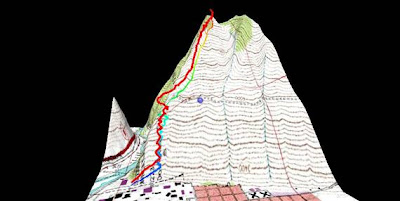 Figure 1: Topographic image of Mount Sentinel and the M Trail1
iPods and the Amelioration of Self-induced Suffering:
A Single-Subject Design
November 17, 2008
David Chenault
Abstract
The use of iPods (portable digital music players) during structured physical exertion has risen in frequency in the ranks of both serious athletes and casual exercisers. The effect of music on the level of perceived exertion is well documented in the literature, though the relationship between perceived exertion and various measures of performance (power, VO2Max, etc) is more problematic. This study uses the author’s personal trials ascending Missoula, Montana’s Mount Sentinel (1850 vertical feet of gain in 1.6 miles) on foot as a single subject test that music will assist in a faster time. Analysis of data gathered by the author is used, along with accounts in the literature and the author’s experience in ultra-endurance mountain bike racing, to advance the hypothesis that while music’s influence on perceived exertion is significant, perceived exertion and the way it influences athletic performance is a more nuanced phenomena than is typically acknowledged.
Method
The question this study attempts to answer is multi-layered. The direct experimental question is whether the author’s use of music played via headphones and iPod would enhance hiking and running speed. The secondary questions are whether the presence of the iPod effects perceived exertion, and whether perceived exertion can be construed as a useful predictor of athletic performance. The study is primarily concerned with recording and charting hiking speed without and with an iPod; the questions of perceived exertion and its relevance will be addressed with reference to the literature and personal experience.
The subject of the experimental trials was the author, a 27 year-old Social Work graduate student. The author has been physically active all his life, and has spent the previous two years training for and competing in ultra-endurance foot and mountain bike events. While varying in distance and difficultly, ultra-endurace events can be best defined as those taking more than 7-8 hours of continuous effort to complete. The author’s training load during these two years was typically 15-20 hours per week, with occasional 1-2 week periods of lower duration and intensity to prepare for or recover from races. In the six weeks before the trials began, the author was engaged in packing and moving to Montana from Arizona, with a total lack of structured training and a significant decline in duration of physical activity during a given week. Since the trial period (and school) began, physical activity has been frequent but irregular. The subject should be construed as starting the trials with a substantial depth and breadth of base fitness, but a fairly low level of specific training and high-end fitness.
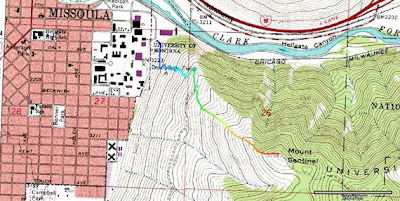 Figure 2: The M Trail
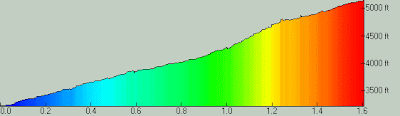
Beginning in August of 2008, and continuing for a period of 3.5 months, the author ascended the “M Trail” from the base of Mount Sentinel to the summit. This involves an ascent from 3300 feet of elevation to just over 5100 feet over 1.6 miles. This was done on a dirt foot trail, the first third of which is well traveled and maintained, the later sections of which are less defined and steeper. (See Figures 2 and 3, shading corresponds to altitude.) Times were monitored on the author’s watch, and recorded to the nearest minute. Starting and ending locations, as well as the trail taken, were identical in each trial. The first nine trials, the first seven without an iPod and the last two with, were recorded before conception of this study, and were thus completely retrospective. The final five trials (with iPod) were conducted after work on the study began. Trials were run at irregular (ordinal) intervals, with times between trials varying from two to 15 days.
Results
Seven trials were first hiked without music (series 1, or A). Times for these ranged between 39 and 32 minutes. Seven trials were then hiked with an iPod (series 2 or B); times for these ranged from 30 to 27 minutes. See figure 4 for a chronological chart of all trials.
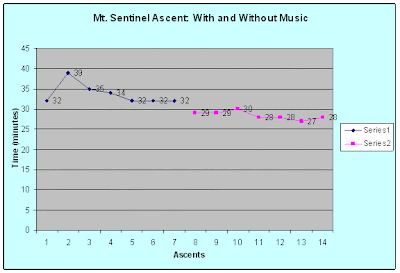
An independent sample t-test was run2, comparing means for the two series. The mean for hikes without music was 33.71 minutes. Mean for trials with music was 28.43 minutes. The difference with 5.29 minutes, and the difference was significant (p<.001). It would seem that this single-subject design supports the assertion that an iPod can enhance athletic performance.
There are several barriers to making this assertion with complete confidence that are worth stating. Most important is the time frame, and the issue of experience and muscle memory. As I became more familiar with the M Trail, I became better able to gauge the stress each section exerted, and better apportion my exertions. I can recall specifically the first trial with music, and being immensely motivated to break 30 minutes. I ran, rather than hiked, more of the early switchbacks, and in my opinion this was chiefly responsible for the much faster ascent. This approach was only refined in subsequent ascents. Another issue might be increased fitness, though based on my knowledge of training dynamics and personal sense of each trial, I would reject that as a factor of consequence. A more accurate test of music’s effect on speed might consist of alternating control and experiment trials.
Another weakness of the design is a lack of rigor in data collection. Because the bulk of the data was gathered retrospectively, the precision and detail of the data was far from being maximized. Future tests would measure to the second rather than rounding to the nearest minute, and divide the test course into sections, recording and comparing the splits across trials. Best of all, GPS technology (such as that used for mapping here) might be used to record and playback the details of each ascent. This would enable the researcher to examine small differences in performance between trials at a high level of detail.
This last could be particularly illuminating, because much of the literature on music and reported perceived exertion (RPE3) points towards the relationship between the two being complex. For instance, in a trial of college-aged males, Matesic and Cromartie (2002) found the music increased running speed in both trained and untrained subjects (trained being defined as having regularly exercised at least three days a week for the past year). Mohammadzahed, Tartibiyan and Ahmadi (2008, p.72) found that “The results indicated that the effect of music on the RPE depends on the fitness of the subjects. There is a large effect of music on the RPE among the untrained subjects in relation to the trained ones.” Szmedra and Bacharach parse their conclusions the furthest, stating
greater metabolic demand; however, oxygen consumption was not different. Perhaps
the music allowed individuals to relax reducing muscle tension thereby increasing blood
flow and lactate clearance while decreasing lactate production in working muscle. The
combined results of this study suggest the introduction of music has a psychobiological
impact on the exerciser demonstrated by changes in perceived effort, lactate and
norepinephrine. (1998, p.36)
It would then seem that music is not merely a psychosomatic aid, or that the psychological dimension of performance is not something that bears oversimplification.
Returning to my own experience during this experiment, I would place the things that allowed me to become faster over time into two categories. First, greater familiarity with the trail allowed me to more efficiently ration my effort, and gain maximum benefit from it. Secondly, I became more whiling to suffer and inflict pain on myself. Returning to trial 8, I can clearly recall running up the final hundred feet, unable to see the top but knowing it was close. As I gained the top my vision became hazy, and for several minutes after I stopped moving I felt rather dizzy. My RPE for that last minute of running would have been a solid 20. I made it up the M Trail faster because I was whiling to try harder, and I was whiling to try harder because I saw that doing it faster than 30 minutes was possible, and was disinclined to disappoint myself.
A similar effect no doubt occurred in the last five trials. The knowledge that my efforts would be made public without question provided a further impetus to put forth maximal effort. This helped log my fastest trials.
Where then does music come into the equation? I believe the quotation from Szmedra and Bacharach puts it best, during the stress and suffering that are an inextricable part of endurance sports, music allows individuals to focus on the mechanics of execution, rather than the discomfort and doubt brought up by the process of achievement. While the individual variations on the ways psychology influences performance are likely endless, the essential process is almost certainly the same. Music would seem to provide a powerful aid during this process. It is for future researchers and athletes to continue to explain just how this is.
Notes
1: GPS data was collected using a Garmin eTrex Legend CX gps. GPS data analysis was performed, and tables and maps generated, using TopoFusion Pro software. Information of Topofusion’s capabilities can be found at www.topofusion.com/features.php.
2: Statistical calculations were completed on SPSS software, version 16.0.
3: The most common perceived exertion scale is the Borg RPE. (RPE: reported perceived exertion.) This scale is a self-report scale numbering 6-20, six meaning no exertion at all, 20 being “maximal exertion”. Generally each number is given a descriptor, such as “15: Hard (heavy)” or “17: Very hard (very strenuous, and you are very fatigued)”. See Borg 1998, page 49.
References
Borg, G. (1998) Borg’s perceived exertion and pain scales. Champaign, Illinois:
Human kinetics.
Matesic, B. & Cromartie, F. (2002) Effects music has on lap pace, heart rate, and perceived exertion rate during a 20-minute self-paced run. The sport journal. Retrieved November 9, 2008 from http://www.thesportjournal.org/article/effects-music-has-lap-pace-heart-rate-and-perceived-exertion-rate-during-20-minute-self-pace
Mohammadzahed, H., Tartibiyan, B., & Ahmadi, A. (2008) The effects of music
on the perceived exertion rate and performance of trained and untrained
individuals during progressive exercise. Facta universitatis, 6 (1), 67-74.
Szmedra, L. & Bacharach, D. (1998) Effect of music on perceived exertion,
plasma lactate, norepinephrine and cardiovascular hemodynamics during
treadmill running. International journal of sports medicine, 19 (1), 32-37.

 Bedrock & Paradox
Leave a comment