
It is easy to dislike mountain biking these days. The industry has gentrified in un-environmental and increasingly, un-human directions, with trail development (or at least, the popular portrayal of it) following accordingly. The 21st century does not need more flow (read; easy) trails, bike parks, or skill and dedication obviating technology.
In my opinion.
The distinction between excessive and incisive equipment is nowhere more problematic and gray than in mountain biking. Packrafting whitewater, for instance, is easier in the era of the extended stern and the cargo fly. Backcountry skiing, both downhill and especially up, is easier with polished tech bindings and boots that fit human movement. In both cases I’d make a distinction between the aforementioned material improvements, insofar as they allow the gear to be less obtrusive over the course of a few hours or few days of travel, and things like a full suspension mountain bike, which does the opposite in erasing terrain as a person moves through the landscape.
There may be little difference in this distinction.
A few years ago I tentatively put my self back into mountain biking, and found both that I enjoyed it more than ever, and that developments in geometry were the very best in human-forward technology, and facilitated my riding a rigid bike better, insofar as enjoyment of the process is concerned, than back in my halcyon days of 2006-2009 (when this website got started). The San Quentin was fun, and several things never felt quite right, so back in November I took what seemed to be a luxurious leap for an expensive, and potentially not so practical improvement, in the Stooge Speedbomb. This bike has exceeded expectations in every way, generally proven to be one of the most subjectively joyful and objectively better gear purchases I have ever made, and provided thought provoking answers to a number of the questions posed by the current state of mountain biking.

Cost being one; with carbon and general complexity having pushed the value threshold of a respectible mountain bike, one that can be ridden regularly and without excessive regard or component failure, noteably high, inflation and all other things being equal. Distinctions can be made here between things which add both cost and quality (of experience), such as dropper posts and tubeless tire systems, and those which probably don’t, more than 8 cogs per cassette and electronic shifting being the most obvious. The San Quentin 1, $899 MSRP currently, being a decent example. The fork and brakes need upgrading almost immediately, the tires and wheels are fine but will inhibit ones riding at a modest skill level, and especially with the new, steep seat angle, a dropper is all but mandatory. Those caveats make the $1399 San Quentin 2 a far better option, though still far from premium in all respects.
Accounting for the current retail value of the Speedbomb as a whole was illustrative, and did a good job of complicating my thesis. 1066 USD is the cost to get the frame set to my door (e.g. minus VAT plus shipping from the UK). Several of the other components are needlessly fancy things I bought ages ago, when they were either the only such option (Paul Thumbie ~10 years ago) or cost much less (King Headset at ~90 bucks in 2004), or the Fox Transfer, which was on sale last month for 60% off. Qualifiers aside, the big picture is that my Speedbomb is a premium rigid mountain bike with mostly sensible, verging on budget, components, and would still cost 3 grand for a new rider, without a back catalogue and time/knowledge/inclincation to shop around. Add a hypothetical suspension fork and a normie drivetrain and brakes, and it is easy to see why the “normal” cost of a “good” mountain bike is up in the 4-5 grand range these days. That is a lot of money, and while it is reductive to ascribe exclusionary intention to manufacturers and bike brands for pushing specs and standards that don’t prioritize value for the enthusiast, it is equally blank and naive to think that the collective direction of mountain biking has, in the past decade, been anything other than elitist.
The ways in which that is a problem is another question.
| Frame/fork Headset Stem Bars Grips Shifter Levers Remote Brakes Wheels Tires B. bracket Cranks Rings Pedals Chain Cassette Derailleur Post Clamp Saddle | Stooge Speedbomb King Ritchey 60mm Spank Spoon 60 DMR Deathgrips Paul w. DuraAce thumbie Avid FR5 PNW 2x Avid BB7 Hunt Trail Wide Mullet Specialized Butcher, Maxxis DHF Generic square taper Race Face square taper 165mm Surly 26t, old bash guard Kona Wah Wah plastic SRAM PC 951 Microshift Acolyte 12-46 (8 speed) Micoshift Advent (9 speed) Fox Transfer 175mm/30.9mm Stooge Fixik Gobi XM | 1066 188 50 40 18 110 15 30 130 420 160 10 180 110 50 15 35 60 320 0 80 |
| Item | Spec | 3087 |
I’ve been quite pleased with the build itself, much of it either coming off several years being tested on the San Quentin (or in the case of the brake calipers, every bike I’ve owned since 2007), addressing shortcomings of the San Quentin, or being a happy coincidence. The longer chainstays of the Speedbomb required a new chain, which revealed that a few of the cogs on the factory San Quentin cassette were worn enough to skip. I stole the 8 speed cassette off M’s bike for testing purposes, and liked the wider spacing so much better with friction shifting I decided to keep it. The only difference between the Microshift 8 speed 12-46 and the 9 speed 11-46 is the bottom two cogs of the later, and the former being both cheaper and one imagines, heavier. I can spin out the 61 inch top gear on a routine basis, and while the 16 inch low gear is low indeed, for loaded backcountry riding I would certainly use something a hair lower. But the overall range is the sweet spot for all around mountain biking, and the roughly 25% jumps in the bottom half of the cassette provide a predictable and comfortable spacing in the sub 35 inch gears that I spend most of my riding time in around here, where longish and often fairly steep singletrack climbs are plentiful. Given the outstanding climbing traction both seated and standing I have no doubt the Speedbomb would work well singlespeed, but given our terrain, and the versatility gears provide, I anticipate keeping a derailleur on most of the time.
Spending a good amount of money to go from a 125mm dropper to 175mm was I worried dollars spent for minimal gain, with the break in ride on the longer post (a ~4 hour tour of South to North Rim and all the way through Gander amd Grafton Wash,, on Gooseberry Mesa) all that was required to put that concern to rest. I could have squeaked a 190mm OneUp on to the Speedbomb, which would have been running right up against the 268mm insertion depth, enough to potentially run into issues if I wanted to run longer cranks or a taller (rails to seat) saddle in the future. 175mm of drop passes the threshold of making a dramatic difference in maneuverability, my current thesis being this happens when the dropper saddle is around knee level, when you’re standing with pedals equal. I’d gladly try more drop, but don’t foresee a strong need to do so. The Transfer itself has been selectively sticky thus far, occasionally not wanting to return to full extension when partially compressed without a butt bump. The (far cheaper) PNW Ridge never did that, so if that issue persists through lube and more use, that would be a disappointment.
The mullet wheels were the other leap into newness with this build, and with the caveat that I’ve not tried any other setup (wheels or tires) I can say the whole rig has been nothing but satisfactory. The 2.6 Butcher up front has quite a square profile which drives into corners with impressive predictability. The day after the Grand Canyon I had free around Vegas waiting for M to fly in, and was impressed by their local trails (above, second photo), which combined the scenery and rolling chunk of the McDowell Preserve with skittery limestone knuckles not unlike our trails here in Helena. I had a blast weighting the front, letting the side knobs hook up, and drifting the more rounded 2.8 DHF rear around sweeping corners, going unscathed amongst all the catclaw. I look forward to riding it with true plus tires at some point, but the all around trail riding ability of the aforementioned tires, combined with the light enough Hunt wheels, has thus far been a lovely combo of liveliness and stability.
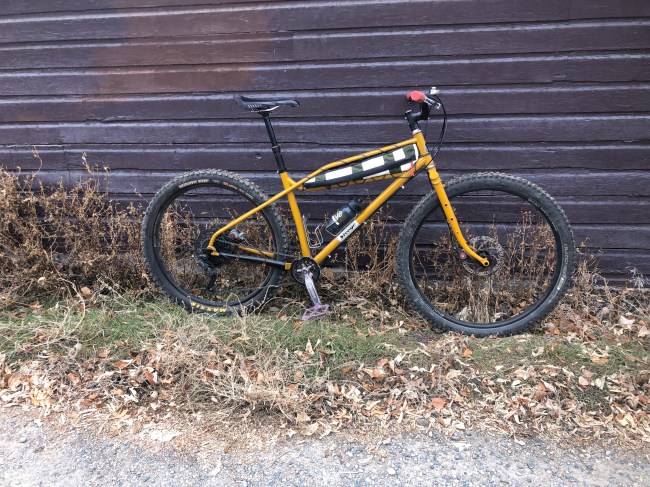
Overall, the ride quality of the Stooge is everything the internet has lately claimed, in a way shockingly distinct from every other bike I’ve owned. That hasn’t been many, but over the years I’ve done a lot of long, demanding, and long and demanding rides on rigid bikes, and the ways the Speedbomb mutes chatter from both ends, making descending and climbing just that bit more settled, has forced me to revise a host of assumptions about rigid bikes being fundamentally the same in their rigidness. The bike preserves all the things I value about a rigid mountain bike, the directness and uniformity with which the rider interacts will all terrains, while smoothing the edges. To return to my suspect theory above, modern geometry (the relatively slack head angle, and with my build, quite low bottom bracket) combines with metallurgical synergy and makes for a bike where one can truly push into riding rigid in rough, technical terrain. Most particularly, that 29 inch front wheel is far enough out front to make a centered riding stance workable even in steep terrain, while (for me, at 5’11” with fairly average proportions) the fork offset and top tube length make for light steering and easy changes of direction, even and especially in the midst of hectic situations. I do think, especially from this perspective of fore-aft balance, that the XL San Quentin, with an effective top tube ~20mm longer than the Stooge, was a hair too big for me. I would be intrigued to try a bigger Stooge, for the added TT length but mainly to experience a similar fit with a shorter stem (and the associated impacts on steering).
I don’t expect the Speedbomb to make the argument of rigid mountain biking to anyone who isn’t already an afficionado, both because it is relatively expensive and has to be pieced together, and (more significantly) because the narrative around mountain biking today is to start with full suspension because it makes learning easier. Which is undebatable. I must remember both that I did not always find mountain biking easy, and that I have been doing it, with significant interruptions, for quite some time. That being so, despite or because of age and being busy and what not, I am objectively riding better than ever, and having at least as much fun as ever in the process, and a decent amount of both of those things has to do with this bike. And with that being the case, it has been money very well spent.


 Bedrock & Paradox
Leave a reply to Vik Cancel reply