I can’t recall which came first, the Jet Pack I bought used well over a decade ago, or my browsing the now charmingly basic and antiquaited Mountain Tools website for their extensive catalogue of hardwear, and unique house blend backpacks, which they’ve sold largely unchanged for a very long time. That Jet Pack had some subtle mojo, with a teardrop shape and countoured side panels which, along with thin and thoughtful shoulder straps, carried very well indeed. Mountain Tools makes all their small packs in two torso lengths, both of which are properly long (e.g. their small or regular is equal to most companies large). The back panel of my long Stealth Pack is 21.5″ bottom to top, which enhanced its unique carry experience and makes it the longest “production” day pack of which I am aware.
Since that Jet Pack the Stealth was on my radar, and last year when a display model Stealth, in size large and made from red 500D cordura, appeared on sale I snatched it.
The Stealth is ordinarily made from Senior Ballistics nylon, and marketed as having a thin, vest-like fit targeted at long, in-a-day rock climbs as well as skiing and mountain biking. Aside from the lighter fabric, mine came with a standard 1″ webbing belt, rather than the “no-profile” belt on the stock model, which is made from 1.5″ webbing, integrated into wings built into the side panel, and operates via velcro and the belt running back through a plastic loop on the other side. This arrangement is low profile and infinitely adjustable, but as I almost never use a hipbelt on small packs, I was delighted to cut mine off and sew a triglide to each end, on the off change I will want to attach a belt down the road.
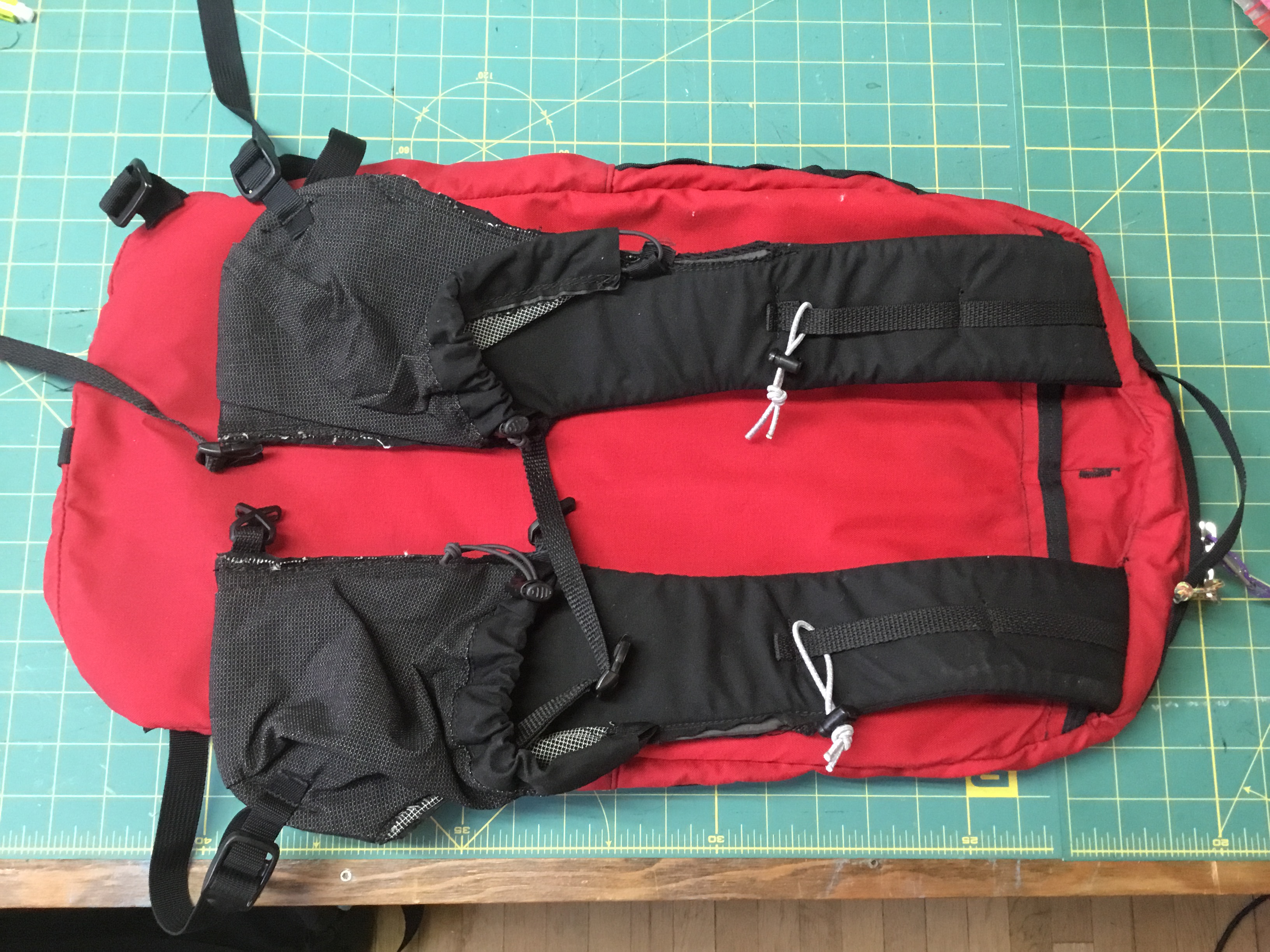

The Stealth’s leading feature is the size and shape; in addition to being taller (21.5″) and wider (12″) than any other daypack I can name, it is very thin, maxing out at 4 inches deep, and tapering a tiny bit at the top and bottom. 4 inches is about as thin as you’d want any pack to be, as thinnner makes fitting common item like a nalgene only possible with the greatest delicacy. The Stealth can, with careful packing and after unzipping the center divider, accommodate something like a standard avy shovel blade without it becoming a pokey nightmare. Mountain Tools specs the large Stealth at 21 liters, which makes for an interesting comparison to a pack like the Osprey Talon 22, supposedly similar in capacity, while being shorter, narrower, and deeper (and far more featured/complex). The Talon looks larger on the rack, while the Stealth can probably fit a bit more, provided the contents doesn’t feature too many bulky, nonmaleable items.
The carry of the Stealth is drastically different from something like the Talon, or indeed most any “conventional” daypack. Small differences in pack depth make for a drastically different wearing experience, and the above comparison highlights this as drastically as any example I can imagine, short of a truly heavy load scenario, like a thin and well secured load of boned game meat compared to a full quarter plopped into the bottom of an empty pack bag. The key feature of the Stealth, hinted at yet poorly explained by the one product photo on the website, is the zip-up center divider. Sewn up the middle of the pack, stopping perhaps 4″ from the bottom and 1″ from the top, is a 4″ deep flap of packcloth with a #5 vislon zipper on one side. You can unzip it up to the top and detatch the zipper, just as you would on a jacket, and open the Stealth for full capacity, or zip it closed and fill either side, with the zip providing structure, keeping the pack narrow, and stopping a partial load from pooling and banging around in the bottom. Depending on the load it can be a bit challenging, or just not fully possible, to have equal size and weight on either side, which in the worst case can feel off, but it is a simple and ingenious system that works well and makes the Stealth highly adaptable.

One common scenario for me is to load the Stealth with a full 10 liter Dromedary for training hikes, which fits into the undivided Stealth with room for snacks, a layer, microspikes, and so forth. I’ll haul this up a local mountain to enhance the strength and power aspect on an aerobic outing, then generally empty some or all of the water for the descent, as that sort of muscle training I find less needed, and work which often needlessly proloungs recovery. With the Dromedary empty, I can zip up the divider and have a tight load which disappears. That this little pack can work equally well with a 25 and 3 pound load is noteworthy. That it is big enough for most day outings, even in the winter, while being 4 inches thick, and with the substantial associated benefits for active pursuits, is remarkable, all the more so for its simplicity.
Apart from the shape the list of features is short. There is a clamshell zip which is on my pack a good bit shorter than on the stock model. There is a center daisy on the front panel, and a side daisy which follows the wrap of the zipper. There is an “energy bar” pocket, which is an open topped mesh sleeve sewn into the top of the divider flap, and just the right size for 2 regular Snickers. The Stealth has a full width, almost full length external sleeve on the backpanel, with a velcro strip closure. This is advertised for a hydration bladder, while I’ve only used it for a 1/8″, flexible foam sheet, which adds just a bit of structure without taking away any of the hug which makes the thing bag ride so well. The stock shoulder straps were fine, if a bit thin and short for heavier loads. My only real objection was the lack of any external, on-the-fly pocketing. An understandable ommision, given the design remit, but one that for hiking and ski touring a found a serious problem. So I made new shoulder straps, with vest style front pocketing and dual strenum straps. The pockets are big enough to hold a 16oz nalgene securely (it will stay in during a mild tomahawk skiing), and the dual sternum straps have been more welcome than I thought during things like tree skiing, and even make the Stealth into a workable running pack (caveat, not my area of expertise). In an ideal world the Stealth would have some sort of top pocket to keep keys, headlamp, etc separate, but due to the divider making that happen would be reasonably complex, and its absence is something I can work around.
Another virtue I missed, for a number of months, in a pack whose function is predicated on a soft, wrapping fit, is the 500D fabric, #8 zipper with no flap, and general pliability in all respects. I made a slightly smaller version recently, mostly out of scrap VX42, with a #10 zip, and the subtantial structure made the pack carry just plain worse in almost all respects. A case can be made that the relatively thin weatherproofing of Cordura will be a liability in some circumstances, but for a pack like this which is not likely to get all that far from the trailhead (in hours), 500D seems like a fine choice. The stock Ballistics is probably a logical upgrade if you’ll be climbing a bunch of chimneys.
Occasionally I allow myself what is essentially a professional indulgence such as this, adding a pack about which I am curious, but whose equivalent I already possess (perhaps several times over), to the needlessly large and functionally redundant piles of packs which occupy various shelves and bins. I can’t think of one such I’ve been more pleased to have than the Stealth, as due to the aforementioned fit it has become by far my most used daypack, and provided a compelling reminder of just how important a thin as possible pack is.
 Bedrock & Paradox
Leave a comment