First (and relevantly), check out mc’s excellent anachronism of the day:
The manner of taking hills was extremely interesting. Nearly all stood on the pedals and swayed the body first to the right and then to the left.
I had a splendid view, as our car was the first behind the “peloton,” or main body, and the effect of some 30 riders in their kaleidoscopic jerseys, all rising up and down, and swaying, with rhythmic unison, was distinctly curious.
Now, for Marshal’s new ride (respond here due to length, and general popularity of the topic):
Versatile bike that can do mountain and road. You can do quite a bit with components, setup, and geo to make this work. However, the number one determinant of any bike’s use is for me tires. So, you’re on the right track with your choices. 35c’s look silly on a frame built for 2.5’s, but they work just fine. Riding a proper monstercross tire (something like a Mutano 44 or a Ritchey ZED 42) offroad is fun, but not efficient fun. The pressures necessary to prevent pinching (>50 psi for my soft-riding self) makes obstacles boingy and traction suffer dramatically. That said, I first rode the White Rim in a day on a Cannondale XS800 cross bike, 35c tire in the back, 42c in the front, hedshok with 22mm of travel. My ass hurt, my back hurt, my beck hurt, but I did climb most of Shafer pretty well for a flatlander.
These days, in the more roadish moments I’ve had with my bikes, I like the old skool Nano. changes in pressure do wonders for it’s speed, and it still works well on technical stuff. I don’t like changing tires. The smaller Karma seems like it’d work in a similar way, as would the new WTB Vulpine.
So, I’d get the monkey. The Soma I had cracked at the seatstay weld, and had general shitty QC issues. M’s Soma (which we got for free, essentially, as a in mail blem) is holding up ok, and it does provide a lot of standover, and thus works well for someone not like me (with a tall inseam and short torso). Overall, the quality of the Surly has continued to impress me. It’s a ton of bike for the money, and is tough as hell. Crashing and wacking into rocks is not an issue, something I value in a bike. I’ve yet to see a 29er with better tire clearance. The geo is solid, and works for road riding and intense tech.
It does have some disadvantages.
-The horizontal dropouts complicate gears and disc brakes.
-Front derailleur clearance can be problematic.
-Not all rim brakes adjust enough to work with the back wheel all the way forward in the dropouts.
The easiest solution to most of these is to use a Hope bolt-on hub. The bolts back out, and the hub drops straight down and out. Almost quick-release type convenience, and it’s been a very, very good hub for me. The front mech issues can be fixed by bolting the hub on ~1cm back, or by getting an old MTB or road derailleur (it’s bottom pull, so you have options).
Here’s the monkey back in early June, geared mode using whatever we had laying around.
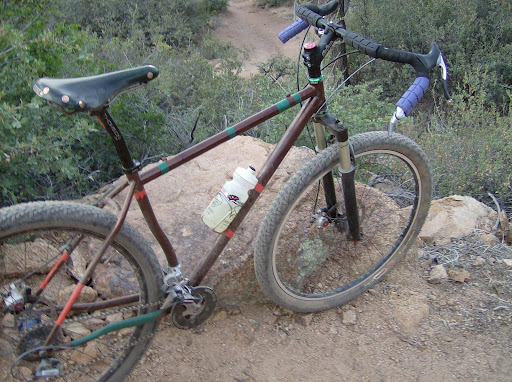 2×5 with a barcon and Kelly Take off. Not the best system for my needs, but a workable experiment.
Monstercross often means drop bars. The added hand positions and aero-ness are advantages, though you’ll want the hook high enough if you plan to use them in the rough stuff, it’s the only viable position for real mountain bike riding. Midges do this well, and provide (IMO) superior ergonomics for all inclines, with some complications.
You’ll need either canti brakes or Avid road discs for standard road levers. In my experience Dia Compe 287v’s (designed for v-brake type cable pull) are worthless, the lever action and thus brake action is horrendous. The Tektro levers just released for this purpose may be better, I could not say. I like old Shimano road levers, their skinny levers and shorter than typical reach both enhance the midge experience. Plus you’ll beat the snot out of them in crashes, and it’s nice to not care.
Midge shifting gives you two real options; STI or bar end. The later is cheap, bomber (especially on friction mode) but less easy to access in the rough. No simultaneous braking and shifting, which will require some adaptation from a normal MTB setup. STI is expensive, requires indexing, and 9 speed is increasingly hard to find. It’s also worth noting that Shimano road and mountain front mechs have different cable pulls, so a triple STI won’t work with (for example) an XT. Been there, tried weird stuff, couldn’t make it work. Plus the trim adjustments (or lack of) don’t play nice together. So, this is my current setup.
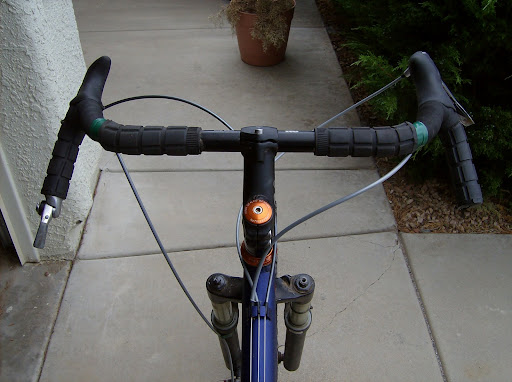
Dura Ace barcon, set on friction. Shifts 2 or 3 rings well, with infinite trim. Ultegra 9 speed STI, shifting 7 in the back (modded SS hub). XT derailleurs and cassette. A good compromise, I think.
Oury grips are mandatory. No bar tape holds up. Cable routing will be improved next time I redo the brake lines and rear shift.
Obviously a more traditional MTB setup would be simpler. But what fun would that be?
Lastly, you’ll want to go check out this and this, definitive words on the subject by Matt Chester. Who may chime in here.
Questions and additions welcome. A subject close to my heart.

 Bedrock & Paradox
Leave a reply to Enel Cancel reply