I’m missing a substantial chunk of the middle of the race, but some healthy integral pieces remain. The results are encouraging, and show just how great Topofusion is at quantifying human performance.
This is the first 17.6 miles of the race, minus the first ~1.5 miles (forgot to turn the GPS on).
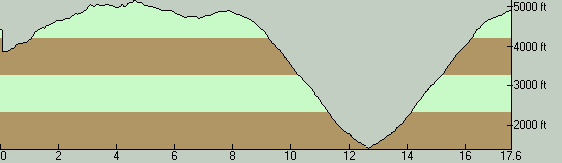

Very encouraging data; certainly a vote for the efficacy of training specificity (ie, the Grand Canyon). Can you spot the aid stations?

These are the last 11.1 miles of the race, leaving the last aid station, going all the way to the finish.
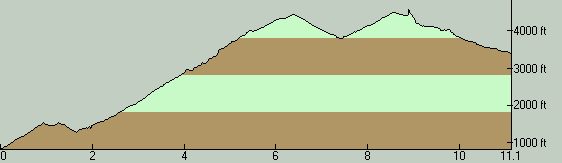
The first two miles are singletrack, and then more trail from roughly mile 3.3 to mile 6ish.

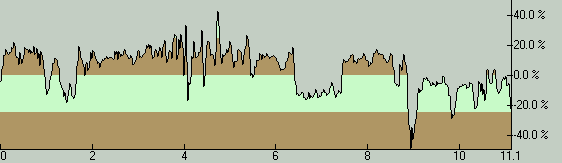
Again, the numbers are very nice. No running forced a resting pace on the flatter sections, and to a slightly lesser extent going down. Thus, I had some juice left for the last climb, which was the second hardest of the day (the last climb in the first series, the first major climb of the race, was the steepest and roughest).
Thanks Scott.
3/26 1016 edit:
Preliminary results are posted. I came in at 19:48, it would seem. Interesting to see the spread, and somewhat confusing given the different start times, and trying to put names to faces-in-the-dark. It will also be interesting to see if aid station #2 made good on their threat to penalize me 10 “boner minutes” for using trekking poles. (I did get some bonus minutes for picking up trash.) Not that I could count the number of racers who commented on wishes they had their own.
In a race that steep, no one is running most of the hills. I passed Karl around mile 2 of the second set of profiles, me going down and him coming up, and even he was walking (with a sour expression) up the ~13% dirt road. Poles rule for climbing. They also make techy descents much more efficient, for those of use who aren’t burly enough to run them all. The bottom half of Thatcher had loads of ~3′ railroad tie stepdowns, and poles let me vault down them with almost no wear on the quads. I love running fast down steep and rocky stuff, but I have a hard time seeing how, from a muscle and foot fatigue angle, it is sustainable for more than 20 or so miles.
Going off that, it’s interesting to note how many 100k (and 100 mile) “runners” came in slower than me. In many cases, I put it off to fatigue from trying to run too much early on. Many folks, 100 mile 5th place finisher Whit Rambach for instance, were absolutely crawling in the last 15 miles. He looked like death when I passed him going down to Cozy Dell on final big descent, and he was moving waaay slow when he pulled into the aid as I left. He must have picked it up at the end, impressive.
All food for thought. Funny how much I get “back” into it once things go well.

 Bedrock & Paradox
Leave a reply to Darren Cancel reply