Theme: perception as reality.
First day in NYC was cool and drizzly, so we stuck to the subway and the MoMA. I was intrigued with the special exhibit Into the Sunset: Photography’s Image of the American West, on one of its last days. The exhibit was in one fairly large room with numerous center walls and partitions, which enabled the exhibit’s stated intention of grouping photographs thematically.

I’m glad they chose this asinine Cindy Sherman photograph for the website, as it embodies well what irked me about the exhibit as a whole. I’ve always liked photograph, at least found it more consistently interesting than many other art forms, perhaps because I’ve briefly pursued it seriously myself. I also enjoy the more obvious ways in which photography puts forth a central question in art, that of objective representation.
On the one hand, Sherman’s photograph is a transparently cute, and cutely transparent, pastiche of a culturally loaded genre, the western film. It’s well-framed, well executed, and aside from the hyperbolic wig and exposed skin could in fact be a movie still. (It could be a replication of an actual movie still, but that’s not especially relevant.) One could easily say that it doesn’t say much. Like much art since Duchamp, it’s execution is good but not particularly complex or laudable, and that leaves the question of merit on the extent to which the works contains anything beyond mere cleverness.
I do think it’s more than merely clever, and that is what troubles me. Since reading almost everything written by Hemingway in high school (including most of the unfinished, published stuff), I’ve been convinced that good art is marked by honesty. Not intentional honesty, where a work might say everything the artist has to say on the subject. More important is unintentional, subconscious honesty. An artist who has developed her process well is able to follow that visions and instinct in a manner pure enough that the finished work gives insight into the artist’s subjectivity. All aspects of their subjectivity, often in ways and towards things which were utterly unknown before (or after, or indeed ever).
I think Sherman’s work begins to point towards the extent to which her highly ironic vision, and indeed much about ironic, “postmodern” art as such, is built on blind cultural privilege. The mere process of driving through monument valley and stepping a few feet off the highway to pose on a tree, which has visually been used in such a manner by many others, paints an allegory for Sherman’s creative process.
And while the exhibit as a whole fulfilled it’s promise of
…illustrat[ing] photography’s role in popularizing ideas of the sublime landscape, Manifest Destiny, and the “land of opportunity,” as well as describing a more complex vision of the West, one that addresses cultural dislocation, environmental devastation, and failed social aspirations. (see website blurb, linked above)
it failed to engage fully with the implications. The notion that the technological rise of photograph and the “exploration” of the American West are analogous processes is a good one. Both are advanced processes accessible, especially in the 19th century, to only a few. Both are privileged acts of appropriation, or one might say (especially of Sherman), of theft. This is probably why the photographs selected came off as an NYC version of the west, with am emphasis on cowboys, urban decay, the porn industry, Vegas, burros, and dramatic B&W lighting. It was indeed photography’s image of the west, but it didn’t really bother to ask: who is photography? (The profligate mis-spellings, misnomers, and plain errors of “fact” also went unanswered. Dine, not Dineh, etc.)
Given the ease and cost of digital technology (in the adjoining room an exhibit discussed the democratizing effects of exhibit-quality ink jet printing), a final sequence of photos taken by inhabitants of the west might have provided a greater depth to the exhibit, and brought it out of the realm of derivative navel-gazing.
It did get me thinking about my own prejudices towards my adopted home.
 I value the west for the landscape, and was most impressed at first glance with the single Ansel Adams in the exhibit, a shot of Mt. Williamson in the Sierra. My first cause for awe is technical (how did he do that?) and the image linked here is only a pale approximation. The secondary reaction was, of course I like it, of all the images in the room it spoke most directly to my vision of the west. Black and white in every sense, harsh, dramatic, arresting, and without people.
Why do I like things like that?
 It’s a relevant question to ask. Somewhere in my files I’ve got an unpublished Arne Naess essay called “The Spectacular: An Enemy?” written in the 80’s after a visit to Canyonlands and Arches. The thesis being that the National Park emphasis on the dramatic assists in a devaluing of whatever forms of nature don’t meet certain, certainly mutable, human criteria. Why are Canyonlands a national park and the San Rafael Swell not? Because the swell had more uranium.
 I wonder to what extent my tendency to groove on and seek out the spectacular and the depopulized reflects a very selective, privileged relationship with the natural world. And in the end only serves to reinforce the illusion, created to allow the use of different moral standards, that humans are categorically different than all the other critters.
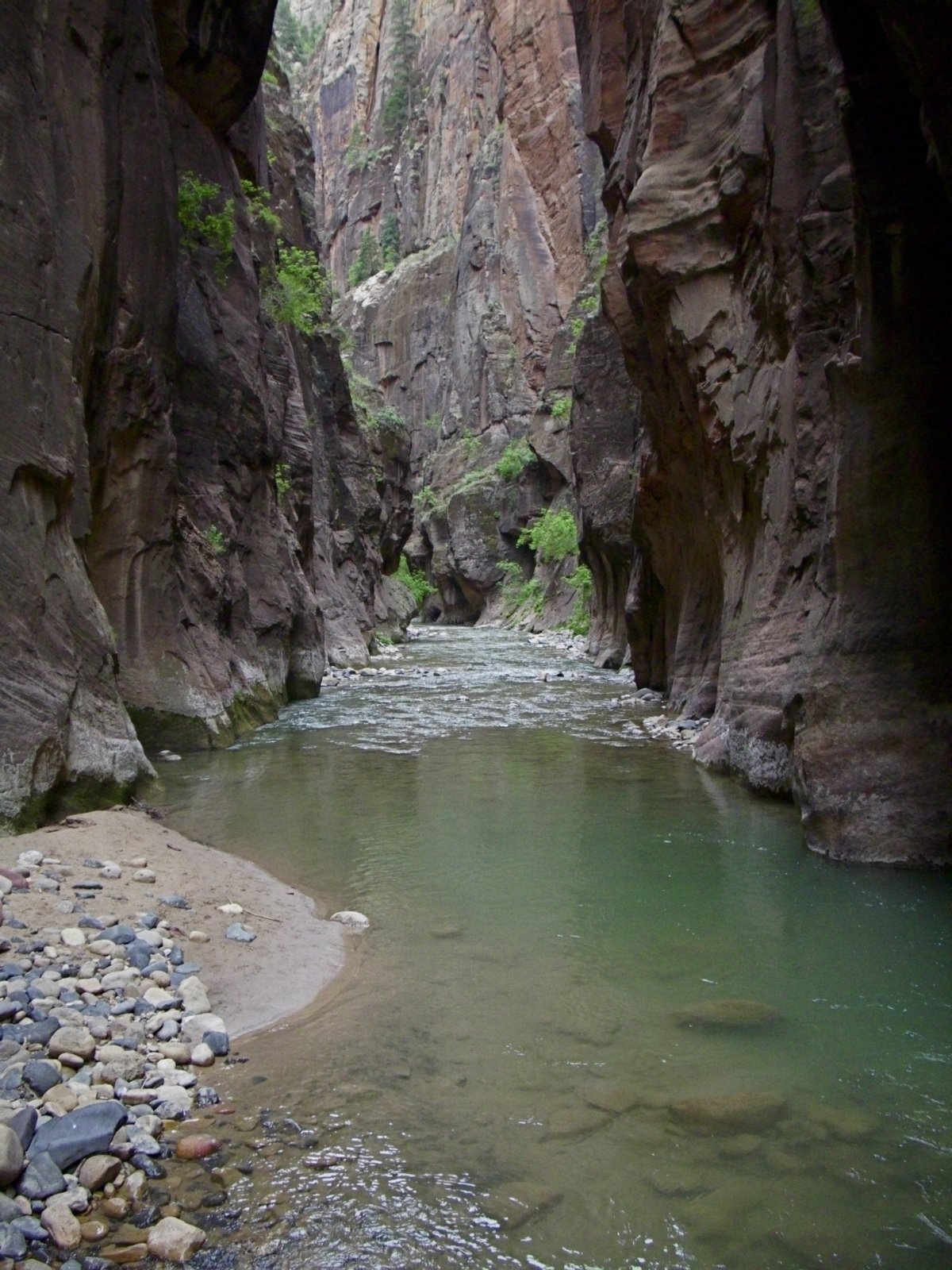
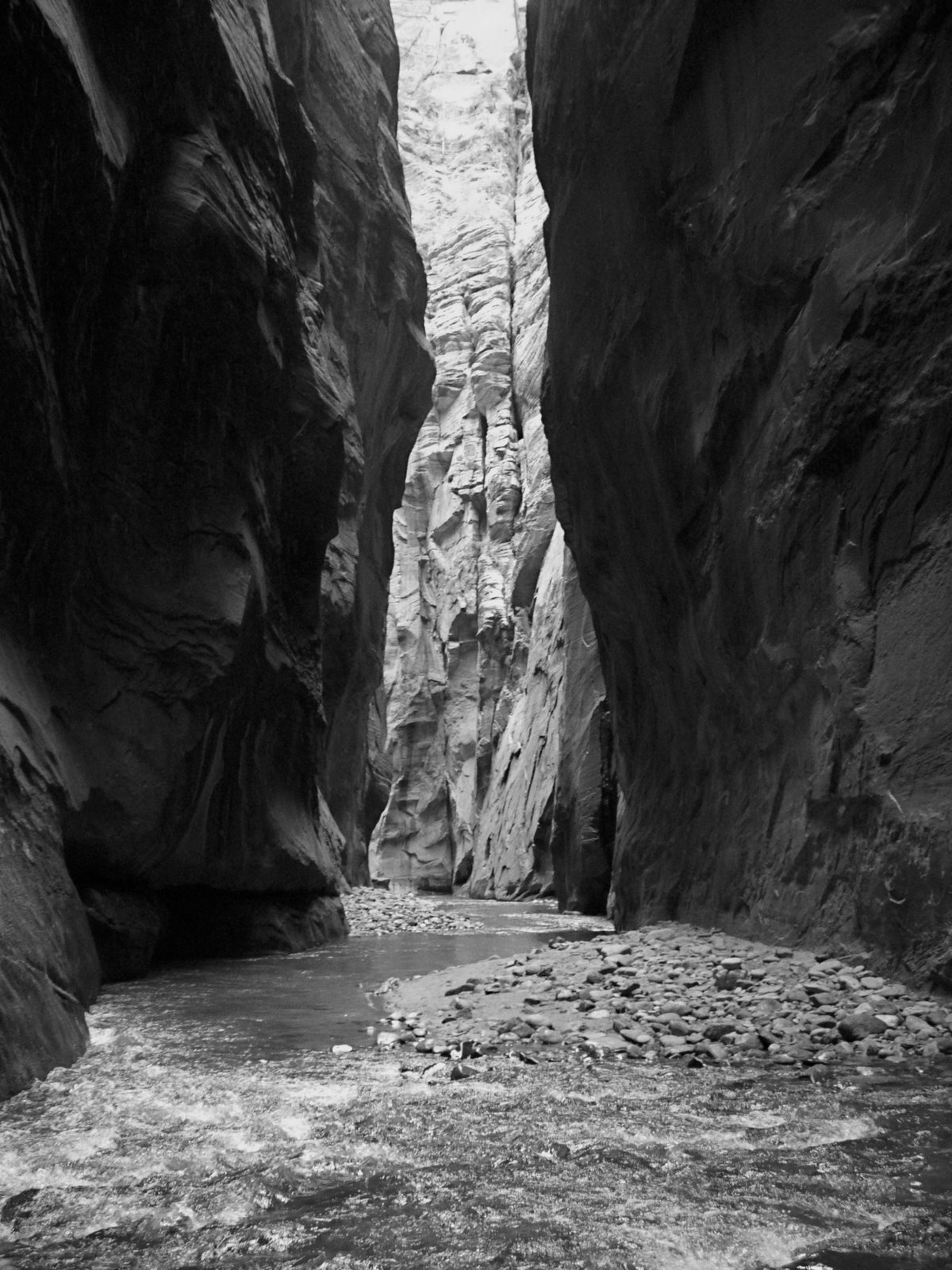
My hike Tuesday ran the gamut. I paid money to ride in a van around to the closest road end. Hiked along the road and then the small stream, thinking that part not so interesting. Took more photos once the walls started to deepen, got frustrated and mostly put the camera away. Reveled in the confluence, and the part below, in no small part because I didn’t run into backpackers on their second day until just above Big Springs (photo from yesterday). Kept walking, kept having fun, and the growing crowds of upstream hikers meant I got to Orderville too fast. The hordes from then on were substantive, and I decided to go for time and bust it out. 6:29, whatever that means. 45 minutes from Orderville to the bus.
So what now. How am I not stealing bits of my own soul with a memory card?

 Bedrock & Paradox
Leave a reply to Grizzly Adam Cancel reply