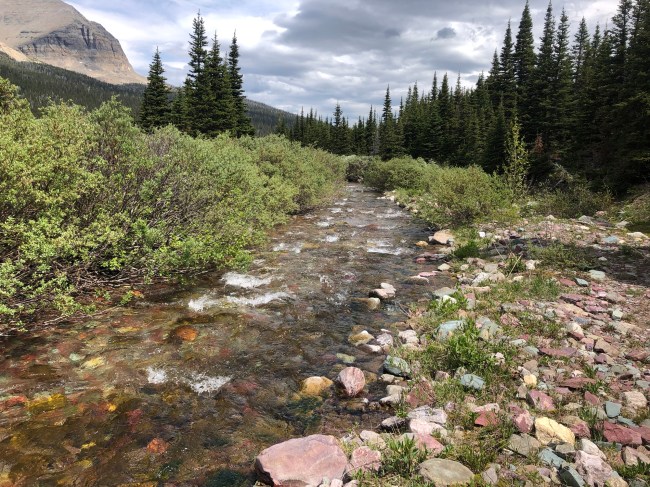
If on seeing the above creek you think it too small to packraft, you would mostly be right. Being there right on the heels of snowmelt would have put another 4-6 inches into it, which would have padded out the rocks, if not the many downed trees and willow seives. For two reasons my decision making was slanted, so I blew up and put on, and hacked downstream for several hours and a number of miles before calling it once I was abreast of a major meadow. Said meadow is possibly the largest non-alpine one in the greater neighborhood which has never had a human trail cut through it, which made it illuminating to see the almost-bikeable tread worn in by elk, moose, and bears. I was where I was with no regard for my own convenience, and thus made an impulsive choice to bushwack straight up the gut of the nearest valley, rather than follow the game trail back up valley to the drainage I had descended. Again, no human trail current or historic, and a tree-band 3 miles deep rather than 800 yards added hours, made for a day that stretched beyond 12 hours and 10,000 feet of gain and loss, and felt like a perfect period on what will presumably be one of the greater projects of my life.
15 years ago I got my first packraft, and, with plenty of enthusiasm and free time, quickly did several of what remain my favorite trips in the Crown of the Continent (and elsewhere). Several months later we moved to Kalispell, and that winter, more to constrain the seeming possibilites than any other reason, made a list of creeks and rivers all up and down Glacier and the Bob. In 2011-2014 a whole lot on that list got explored, with my ignorance consistently fading beyond my enthusiasm. I bushwacked, I portaged huge percentages, I made it through lots of stretches with a mix of innate conservatism and dumb luck. Whitewater and wilderness skill, along with the proper exploratory mentality, came along later, and so the list has inflated and winnowed irregularly over the past decade. There are lots of things I can’t imagine ever revisiting, a few things I should (with a better boat and more skill) but am frightened of, several others descended that I never would have imagined to be floatable, and plenty (particularly in the past few years) that I imagined might be excellent and turned out not to be. That creek last month fit into this final camp, sadly, and was the very last on the list. Which was of course why I bothered to float it at all, along with having already carried a pack full of boating gear 4k up a ridge and then down the other side.
Since 2022 I’ve been revising Packrafting the Crown of the Continent towards what I’ve been calling, in my imagination, the final edition. In contrast to the first, and the current slightly revised edition, that new one will have virtually everything on that initial list. In 2017, sitting in a coffee shop in Fruita trying to distill the previous years of firehosing myself with a deep packrafting education, I decided to cull all the waterways which had what I deemed extreme wood hazard, a term I continue to use, which broadly means enough wood that both due to efficiency and due to mental stress floating is slower than walking down said drainage. There are a lot of said waterways; one imagines that even prior to early 20th century fire suppression most things currently called a creek in the Crown ecosystem are that woody most of the time, with the exceptions either concentrated on the less vegetated east side (the forks of Birch, for instance) or happening during fairly isolated occasions in their history (Monture, which due to two successive fires a ~decade ago went from a serious, seriously enjoyable creek to the unrunnable trap it will likely remain for decades). Given that I will almost certainly never again approach the level of paddling productivity I had ’10-’14, it seems reasonable I put enough of my current knowledge into one book, such that it will age as well as possible. I expect this new edition to come out late this year.
All that said, 90+% of folks who have bought the guide in the past 8 years will find little if any value in the new edition, save perhaps in some more focused historical and philosophical tidbits, and perhaps better writing. Beta for the South Fork has not changed, save the average season moving earlier, getting shorter, and the urgency of wholistic minimal-impact travel increasing.
As for me, I’ve felt a bit dizzy and lost in completeness for the past month.
 Bedrock & Paradox
Leave a comment