Over the years I’ve made, and used, many very large backpacks; and while being a firm believer in having huge capacity and moderating packing choices rather than enforcing discipline with a crammed pack, have still occasionally found the fleet coming up short. Our family Isle Royale trip two years ago was the best example; with two larger packrafts and boating and backpacking gear and food for 4 for 8 days. M used my main hunting pack, and I rather hastily threw together a big, basic bag on a Seek Outside frame. It worked fine but was too tall, too skinny, and not tough enough for the long haul, so a year ago I ordered some expensive fabric and set out to make a pack bag that would never be too small.
Living with the SWD Big Wild 100 has sold me on a ~50 in circumference as the max practical. I’ve made bigger, a custom bag for a Barney’s frame, which is 15.5 inches wide the whole way up, and that in turn allows for a ~60 inch circumference without looking like it gets too deep relative to width. On a Seek Outside frame, a 14 inch front and back panel width allows for 11 inch side panels, which is capacious without demanding very careful packing under all circumstances. To maximize potential, and allow for some flexibility in functional size, I built this bag with a continuous 50 inch circ, and put three 1 inch compression straps at 12 inch (center to center) intervals up the front panel. Beyond lashing on things like a bow or rifle or foam sleeping pad, I use these to shrink the volume before I load up the pack. Some times a tall, thinner pack is the way to go, while in other cases (this bushwack is an ideal example) a fatter and shorter load is preferable, even if that approach is less ideal from a center of mass perspective.


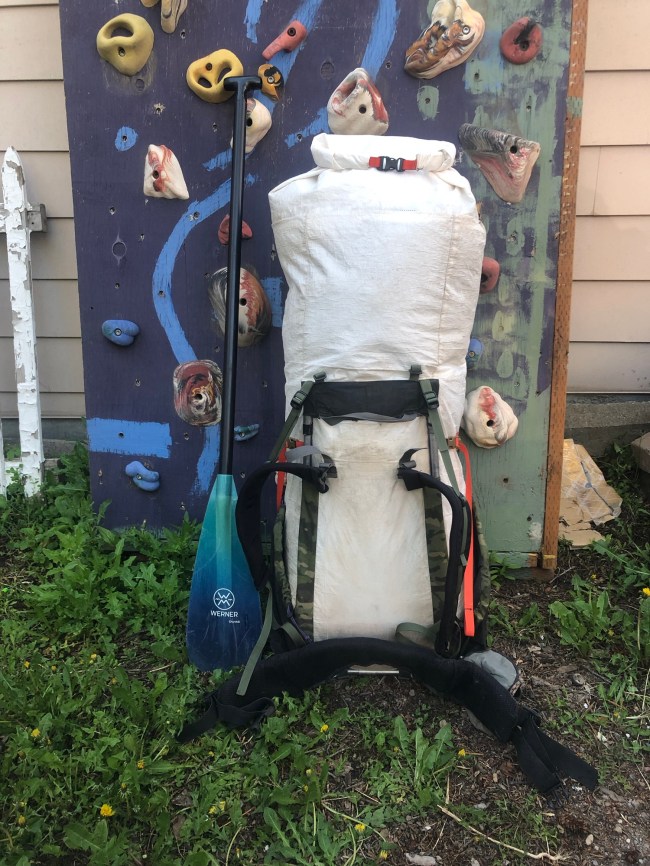
I held my breath at the absurdity of it and made this bag 60 inches tall, unrolled. That is half again as tall as the Big Wild 100, and looks ridiculous both empty and full (the paddle pictured is 55 inches tall). It makes the bag an excellent ground sheet, and preserves potential (for another trip like Isle Royale, where I’m carrying a boat and a tent and multiple sleeping bags, I’d use most of it), while being only marginally annoying to load. The front panel/base, side pockets, and structural reinforcements are black 800D Ultra, the side and back panels (up to a 40 inch height) are white 400D Ultra, while the “extension collar” for the final 20 inches of height in 200D Ultra. I fold the collar down over the pack when loading, making the whole thing more managable and “normal”. For scale, on the Grand West loop mentioned above I had a full whitewater packraft kit (big boat, drysuit, foam PFD inside the bag), food for 8 days, and a minimal backpacking kit, as well as 2+ gallons of water most of the time, and all that barely filled the pack past the 40 inch mark.
Features-wise things are pretty minimal. A roll top that clips to itself, 2 removable top straps that I will probably only ever use for packing out elk heads, the three compression straps on the front, a compression strap on each side (with a QR buckle), and side pockets. Over the past few years I’ve concluded that on packs with side panels deeper than 8 inches or so it is pretty hard for pocket volume to not get out of hand. If they’re that wide, and full enough for things like a nalgene when the pack is stuffed full, they’re big enough to scrape and catch, collect pine needles and debris like crazy, and often smaller things get buried and lost. So these side pockets are partial depth, six inches of the side panels, dimensioned out 3.5 inches, and 5 inches tall against the used going up to 14 inches tall on the other edge. They swallow one nalgene (including a 48 oz silo) with ease, and stay tucked against the user when full. A good compromise, with dimensions I’m happy with. The extra flat pocket made of camo 500D Cordura was an improvisation and mostly aethetic, though they do work for holding trekking poles and the like.
There is no padding or structure in the back panel, just one layer of fabric, so keeping the load from poking you or barrelling is entirely down the technique. A major point of a bag this big is to never have to stuff and cram, and thus I don’t find this an issue or compromise at all. The benefit of such a minimalist approach is that, with a cushy hipbelt, the belt pouch shown, and a 27 inch tall frame and bomber, overkill materials, I have a ~140 liter backpack that empty weighs 3.5 pounds on the nose. Reasonably sure I’ll keep this one around for a while.


 Bedrock & Paradox
Leave a reply to bigadventuresmallmind Cancel reply