It’s too bad Ryan Jordan’s blogging is so stochastic. When he does write, it’s always worth reading and is usually one of the more thought-provoking things I’ll encounter online in that particular week.
The most recent post is no exception.
In it he discussed favorites bits of gear (and when I say gear I mean outdoor gear, of course), and in doing so illuminates two ways of understanding simplicity: practical simplicity (which might be summed up as efficiency), and natural simplicity (which has to do with kit that helps illuminate and reveal the experience at hand, and is thus properly difficult to summarize). He goes on to discuss how rare the blending of the two is, how infrequent it is that a truly clean and efficient (not the same!) piece of gear also serves to cleanly illuminate the experience of being in the wild.
I can’t disagree. And after I thought about this for a minute, it struck me as quite sad.
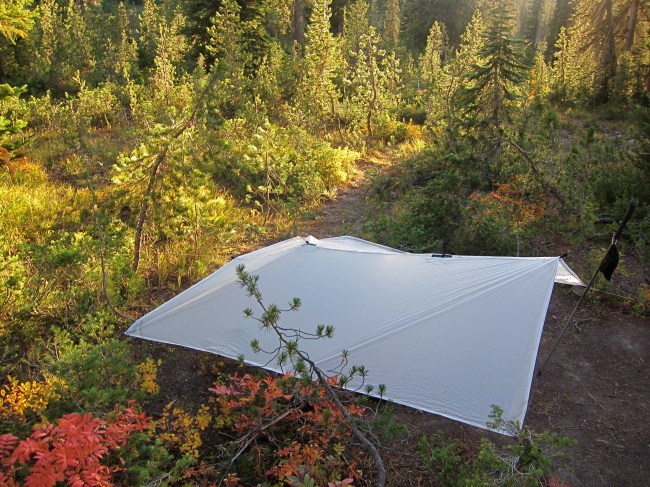 My 80″ by 90″ Spinnaker tarp this past weekend.
This sadness might be the central contradiction at the heart of modern wilderness recreation, which historically is itself an absurd idea. Our not so distant ancestors would have presumably been appalled that our lives had become so full of ease that we now seek out hardship in the outdoors purely for entertainment (in the complex sense). It’d be an interesting historical study to examine the accounts of explorers since Christ and try to determine when, and under what circumstances, human enlightenment started to be a conscious end sought. It’s hard to read the journals of Lewis and Clark without supposing that for the captains at least, “fun” featured prominently in their months in the wild. So to with Powell, in every subsequent voyage after the 1869 trip science is less and less of a screen for the joy he obviously found in the Colorado Plateau. And the Kolb brothers too; even reading through Ellsworth’s breezy account of their epics one cannot but see fun and personal challenge as the primary mover.
The paradox here is that while we make seek to recapture some primeval simplicity by going outdoors, our ancestors even going back further than instinctual, tactile memory allows were tool makers. Gear allowed them to expand across the globe, and while we need far less than we think, humans are still too naked to do without substantial technology in all but the mildest places on earth.
It traces back to the paradox of us humans going outside for fun in the first place: we’ll cut gear (insulation, shelter, food) down to the minimum allowed by our idea of what safety will mean, and no further. This gets us closer to our ancestral experience (or so we think), and facilitates natural simplicity, but the process of doing so when for comparatively little weight gain and considerably less contemplation we could walk out the door comfort all but assured points towards some kinds of simplicity only being simple when looked at from a very limited perspective.
I’m taking skill out of the equation here, and perhaps oversimplifying generally, but the point stands. Simplicity is then a mere product of human engineering. Right?
I’m not so sure. Our gear has become so good, it does so much work for us, that our practice of outdoor adventure becomes more and more vulgar in its ease and leisure. This isn’t to say we ought to wantonly cut gear and carelessly suffer, but we should remember that more refined, aesthetic, and noble ways of enjoying life have to do with “creating something beautiful” which can be shared with others, not with an experience which is in the moment always beautifully comfortable.
(And yes, I know I’m avoiding Ryan’s exit questions. My answer would be something to the effect that gear makers, even the cottage shops, make a profit selling aspirational gear rather than experiential.)


 Bedrock & Paradox
Leave a comment